
Bacterial growth in diluted shampoo/conditioners
Jan
Is it a myth that there is bacterial growth in diluted products?
Most groomers nowadays know that it’s not a good idea to save diluted products for a prolonged period.
We have been educated by posts on social media and grooming magazines by shampoo manufacturers and grooming educators.
I still how ever sometimes see posts/comments from old timers like myself that says- yeah, you say that-but where is the proof? I have been doing this for 30 years and never had a problem.
To show that this is not just an opinion from people who want to sell more shampoo or blame you instead of their products if anything goes wrong, I have put together a post with some links to scientific papers.
As always, I try to make it brief- but I am not sure if I can succeed in that 🤣

I learnt about this in the 1990s when I was a veterinary nurse at a large animal hospital. We washed every dog before they went home.
We suddenly had an outbreak of unexplained skin issues in dogs that had recently left the hospital, and a lot of effort was put into finding out what caused it.
After extensive sampling of both skin samples and environmental testing, it was concluded that the cause of the issue was bacterial growth in the shampoo containers in the bathing area.
Once new routines were put in place, the issue was gone.
This is not an isolated example. Comments in grooming groups show that other larger veterinary facilities have had similar experiences and the same results after all the testing was done.
A lot of people say -I have always been using diluted products that have been stored for many days, and I have never had a problem in my many years of grooming.
And that might be completely true; they might have been lucky.
But when you investigate, you find that they occasionally have dogs with “allergic” reactions and blame the owner for not telling them that the dog is allergic. Or they blame the shampoo manufacturer for selling bad products.
And those reactions could be a mild bacterial infection and not an allergy/ badly manufactured product.

What is it that happens?
Our environment is full of bacteria—a bit scary when you think about it 😱 They are usually no issues for us. But once in a while, there will be too many of them, and that’s when they turn into an issue.
One of the most common issues for us as groomers is Pseudomonas aeruginosa.
( read more about it on Wikipedia
https://en.wikipedia.org/wiki/Pseudomonas_aeruginosa )
This bacteria is present everywhere -in water, skin, and soil- and thrives in dark, moist areas that lack oxygen.
It can cause anything from mild skin infections to severe internal infections that kill you.
Our immune system can usually control these bacteria, but a weakened immune system, caused by ongoing health issues or being on immunosuppressant drugs, can cause severe problems.
Or if you suddenly get exposed to a large amount of them in one go -like being washed with a product that contains a large amount. Then it’s hard for the immune system to fight them all in one go, and you can get an infection.
When we have an issue with these bacteria in the grooming salon, it is usually a combination of several factors that makes a recipe for the “perfect storm”
Here are some examples:
You have a matted dog that you are brushing out, and the dematting irritates the skin, opening it for bacteria to get further down into the skin and multiply. If you add products that are contaminated with bacteria, the bacterial load will be too high for the immune system to fight, and you will get a skin reaction.
Or you have a shorthaired dog that is in for de shedding. If you scrub it too hard, the short, stiff hairs will move around in the hair follicles and cause irritation around the follicle opening. That irritation will lead to inflammation, making the skin more vulnerable and opening it up for bacteria to get into the skin. If you add a product that contains bacteria, that will again be too much for the immune system to handle, and you get a skin infection.
Another scenario is if you have a dog that has been on steroids for a prolonged time. The steroid treatment causes the skin to be thinner and more fragile. It also shuts down the immune system, leaving the dog without defence against bacterial infections.
You pluck the ears because they are very hairy. The plucking causes itching, and the dog scratches around its head a little bit. That scratching damages the already fragile skin, and if you wash the dog with a product that contains an excess amount of bacteria, the bacteria will make its way down into the skin and multiply, as the immune system is not killing it; it is shut down.
Infection with Pseudomonas aeruginosa in dogs with a compromised immune system can lead to sepsis and death, so we must be careful when dealing with those dogs.
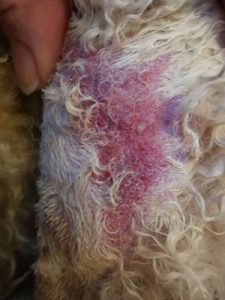
The warm water itself helps the bacteria get into the skin, opening up the scales on the surface and allowing them to penetrate further down.
How do the bacteria get into the products?
Grooming products are full of preservatives to prevent the growth of bacteria. But they only last for a certain amount of time, and then the effect starts to wear off. The protection is weakened if your shampoo is on the shelf for a long time, and this can also happen if it is stored at high temperatures.
Once you dilute the product and the preservatives, the protection is almost gone. Remember what I said in the beginning: This bacteria is present in the water, which means that you are adding bacteria to the mix.
So, you now have a mix with a small number of bacteria and very few preservatives to fight it. That will be no issue if you use the diluted product within a couple of hours, as there are only a small number of bacteria.
But if you then decide to store it for a day or two, that gives the bacteria time to multiply in that bottle. Remember that it thrives in moist, dark, and warm environments….
Despite the full amount of preservatives, bacterial growth can also occur in undiluted products. The preservatives can only deal with so much bacteria and will eventually become ineffective.
This happens when water is present in the product container. The bacteria will grow in the water, not in the product itself, but every time you pour some product into your mixing bottle, some of the contaminated water will also be transferred.
There are several ways the water ends up in the product container- the two most common are:
condensation in the container from the humid air in the bathing area.
Water entering the container when you wash the dogs
If you store your products close to the bath or in the bath, there’s a high risk of water entering the container every time you wash a dog. This is the most common reason for issues with undiluted products.
The best way to avoid this issue is to store them in an area that is either so far away from the bath that there’s no risk they get showered or keep them covered if you must keep them close to the bath. (In a cabinet with closed doors) Keeping the container inside the bathtub is not a good idea, as that will really open up for water to enter it.

So, where is the science in all these claims now? I have never had any issues……
Here are some scientific papers that discuss the issues:
“Bacterial contamination of shampoo or cream rinse seems pivotal in developing Post grooming furunculosis.
In particular, self-serve dog washing facilities and grooming parlours using large communal containers of bathing products have been implicated.
Recommendations for avoiding post-grooming furunculosis include diluting shampoo or cream rinse on the day it is used and sterilising all community containers (including pump nozzles) daily.
Recognizing Pyoderma, More Difficult than it May Seem
Kinga Gortel, DVM, MS
https://sci-hub.se/https://doi.org/10.1016
/j.cvsm.2012.09.004
” Pseudomonas aeruginosa contamination of dog grooming shampoos and conditioners was significantly associated with product dilution. Contaminated grooming products may predispose dogs to severe bacterial skin infections.”
.Pseudomonas aeruginosa isolation from dog grooming products used by private owners or by professional pet grooming salons: prevalence and risk factors
Elad Perry, corresponding author 1 Gila Abells Sutton, 1 Lotem Haggag, 1 Marcelo Fleker, 2 Shlomo Eduardo Blum, 2 and Ronnie Kaufmann 1
https://www.ncbi.nlm.nih.gov/pmc/
articles/PMC9542640/
” This case report describes a dog with post-grooming furunculosis. Pseudomonas aeruginosa with an identical genetic fingerprint was isolated from the skin lesions and from the shampoo used before the disease onset.
Conclusion and clinical importance: Our clinical investigation suggests a link between Pseudomonas-contaminated shampoo and the development of post grooming furunculosis, underscoring the need for hygienic management of shampoos to help limit this disease.”
Molecular confirmation of shampoo as the putative source of Pseudomonas aeruginosa-induced post grooming furunculosis in a dog Heng L. Tham*, Megan E. Jacob† and Petra Bizikova*‡
https://sci-hub.se/10.1111/vde.12332
” The dog was diagnosed with post-grooming furunculosis and mitral valve endocarditis ACVIM stage B2. The culture of the lesional skin and the shampoo used to wash the dog before the onset of the skin lesions revealed the presence of the same bacteria, evidencing a clear link between bathing and the development of the skin lesions.”
Post-grooming furunculosis in a dog
L. Rutten, P. Smets, S. Vandenabeele
https://openjournals.ugent.be/vdt
/article/id/75766/
” furunculosis following water immersion or grooming has been described in dogs. Furunculosis has been proposed as a sequela to follicular trauma from vigorous manipulation of the skin and coat (i.e., brushing or coat-stripping), followed by bathing with contaminated shampoos or conditioners, particularly bulk formulations that are diluted for use in commercial grooming facilities.”
.Clinical and histopathologic features of dorsally located furunculosis in dogs following water immersion or exposure to grooming products: 22 cases (2005-2013)
Christine L. Cain, DVM, and Elizabeth A. Mauldin, DVM
https://sci-hub.se/10.2460/javma.246.5.522
It is not just grooming related
The issue is not isolated to dog grooming. It happens everywhere where you have liquid products that we handle.
This Japanese study done on products used in hairdressing/barber shops shows a large volume of bacteria in the products that are used
“To determine the extent of contamination by bacteria of hair-washing shampoo and rinse used professionally at barber shops and hair-dressing saloons, quantitative isolation of bacteria was performed by using a total of 39 samples of shampoo and rinse fluid obtained from 17 facilities.
It was found that a maximal number of 1•~107/ml colony forming units/ml of bacteria were isolated from 60.7% (17 out of 28 samples) of the shampoo and 45.5% (5 out of 11) of the rinse. Gram-negative bacilli were the predominant strains (87.9%) involved in bacterial contamination, and the major isolates were Serratia marcescens (43.3%, most frequently isolated), Pseudomonas cepacia, P. fluorescens, P. aeruginosa and Klebsiella pneumoniae, all which are widely recognised as nosocomial-infection causing pathogens.
These results indicate that hair-washing liquids for professional use are contaminated with a large number of gram-negative bacteria, which could cause nosocomial infections. Therefore, much attention should be paid to the sanitation and cleanliness of the shampoo and rinse for hair-washing.
Bacterial Contamination of Hair Washing Liquids
Kazuhiko Amemiya, Fumiaki Taguchi
https://www.jstage.jst.go.jp/article/
kansenshogakuzasshi1970/68/2/
68_2_177/_article

This paper proves that you can have contamination in diluted products and the danger this contaminated shampoo can be to immunocompromised individuals
“The diluted shampoo used was heavily contaminated with Pseudomonas aeruginosa, which infected the small nicks from shaving. These infections fulminated in these immunosuppressed patients and proved fatal to one.”
Hair Clipping: Another Hazard for Granulocytopenic Patients?
https://sci-hub.se/https://doi.org/10.1093
/infdis/158.3.655
How can I reduce the risks?
The main takeaway is that you should not store diluted products.
Mix what you need for the day and dispose of any leftovers at the end of the workday.
Rinse your mixing bottles with hot water, and it’s a good idea to also give them a quick rinse with a disinfectant and then store them upside down. That allows any leftover water to drain out and the inside of the bottle to dry. Bacteria like moisture, so a dry container won’t be a beneficial environment for them.
Never put your fingers inside the product container, that is a sure way of adding bacteria. A recent study showed bacteria growth inside a shampoo bottle cap in a grooming salon, so make sure you don’t touch the inside if you are going to reuse the cap.
Wash your hands before handling a pump that you are going to put into a container
If you are using pumps for your products, ensure they are cleaned inside out and disinfected before putting them in a new container. Pull it apart and clean out any remaining products from it.
Put a cap on the pump opening to reduce the amount of humid air that can enter it.
Don’t store products in a hot environment. And don’t bulk buy products that are stored for a long time. Preservative efficiency is reduced over time, which allows for bacterial growth.
Don’t keep your products in the bath/just beside it so water can enter the container.
Put the opening date on your containers to make it easier to track how long they have been opened.
If you have a container that has been open for a couple of months, make it a habit to check the content daily before you use it. Smell it and look at it; you don’t want a foul smell or change in colour.
If you want to learn more about product storage and general product safety, listen to this episode of the GroomPod, where Dave Campanella, a manufacturer, talks about the subject.
Barbara Bird, one of the hosts, also talk about Pseudomonas aeruginosa.
I hope that my brief take on the subject have given you a bit more information about the subject and also showed you the importance of proper handling of the products that we use.
I know I have talked a lot about the risks for the dogs, but the risk applies to you as a groomer as well.
If you have damaged skin on your hands and a compromised immune system, you are at high risk to develop a severe skin infection from contaminated products – please dont take that risk, remember the cancer patient that died.
Pingback: シャンプーボトル洗うの面倒!解決策5選&洗わないリスク | 暮らし術