

A deeper look into the coat’s role in the dog’s thermal regulation
Jun
In the earlier post, we established that every breed has the same thermal regulation—there is no special rule for so-called double-coated breeds. We know what risks are involved for the coat’s appearance if we clip them, so let’s take an extra look at the coat’s role in the thermoregulation process.
Is the coat actually keeping them cool like some people claim?
Before we go into the thermal properties of the coat – let’s go back in history for a while.
To understand the coats, we need to remember that all breeds originated from dogs with a specific purpose. Evolution created specific dogs for specific needs in different parts of the world.
Man didn’t have dogs as pets – they all had a working purpose and had to cater to their own needs. They didn’t have clothes or shelter – the dogs got a body and coat that was adapted to the environment where they lived. Dogs that didn’t survive the climate they lived in didn’t reproduce.
(Description of coat characteristics, breed development and history from FCIs breed standards www.fci.be , general properties of different coats from the book Ecological and environmental Physiology of mammals)
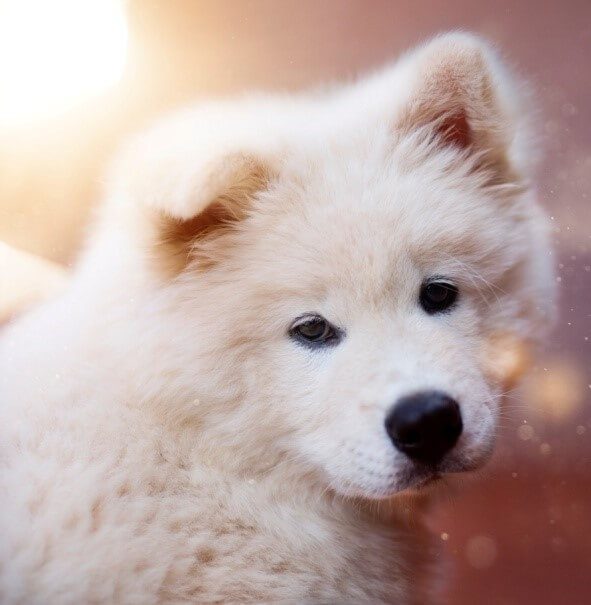
Dogs developed in Arctic climates had thick coats with hairs standing straight up. The undercoat is very dense and super efficient as a heat preserver, allowing the dog to withstand temperatures down to -40/50C.
The coat forms a shield around the dog, preventing snow from reaching the skin. The snow gets stuck on the surface, and because the undercoat is insulating, no heat is released to the environment, causing the snow to melt and wet the dog. The thick undercoat also prevents wind from getting into the coat and from releasing the warm air stored within it.
The average downpour in these areas is snow.
All areas of the dog are covered in thick hair to prevent heat loss, and the ears are small and the nose short for the same reason ( Devito,Russel-Revez &Fornio 2009 ) . They are all on the bigger side as it’s easier to keep the heat in a larger body mass than in a small.
The temperatures in the areas they were developed in varied from -50C to +15C (sometimes up to 20C but that’s not the norm) – so the main purpose of the coat is to keep them dry and warm.
The Arctic breeds are our average sled dogs, but they are also used for hunting.
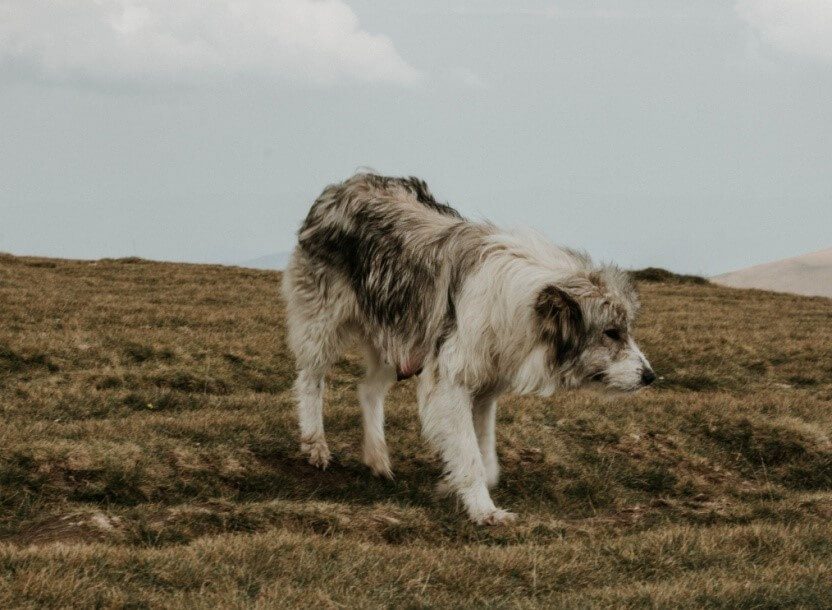
Dogs developed in areas with mountains got a coat that is slightly different. It must be able to withstand both rain, snow, and sun radiation. There is also a difference in temperature variation depending on where in the world they are, but you seldom see that extreme cold as in the Arctic. The breeds are mainly used for herding /guarding livestock and a lot of them lived with the livestock 24/7.
The coat consists of thick, long guard hairs that lay down -following the dog’s body contour. There is a thick, slightly longer undercoat -but not as thick as on the Arctic breeds.
The thick, long guard hairs that lie down prevent water from getting deeper into the coat. Water will be transported away from the body by the hair shaft and fall down onto the dog’s sides, like on a slate roof. The hair on the shoulders and the back is thicker for that reason—it acts as an extra umbrella.
When the wind blows, the hair moves and releases some of the heat trapped inside the coat. However, the flat angle of the hair prevents wind from penetrating deeply into the coat, and the undercoat can still retain a layer of warm air close to the skin.
They have a thicker undercoat in the winter for extra heat prevention and a thinner undercoat during the summer.
The thick coat also acts as a shield against damage from predators that attack the herd.
The temperature in these areas is not as extreme as in the Arctic as the mountains keep the climate on a more “normal” level. It’s still off course a bit of variation depending on where you are, but the average would be around 5/-10 °C in the winter and +20/25C in the summer.
It’s more rain than in the Arctic areas as the temperature is higher, and this is why the coat is lying flat rather than standing up.
The dogs are big as they are meant for protection, and it is also easier to keep a big body mass warmer during cold weather. The ears are quite small and have hair on them on the outside -they hang down to protect from heat loss, but are easy to move to capture noise from threats.

We then have the hunting breeds developed in warm, dry desert climates. They are large but thin-bodied, with long legs, so their body mass is usually lower than that of Arctic breeds. The coat has silky, shiny guard hairs and a thin undercoat. The warmer the area where they are developed, the shorter their coat is.
The shiny guard hairs reflect some of the sun rays away from the surface, and the reduced amount of undercoat will allow for wind to release the heat within the coat.
Their thin bodies make it easier to keep cool, as a smaller body mass is easier for the body’s thermal regulation system to maintain core temperature. They don’t have much body fat because fat prevents heat loss. The long legs are developed for hunting, but they also allow for heat loss as the hair on the legs is thin.
The coat on the stomach and under the chest/armpits is very thin to make conduction of heat to the ground easier.
Some of them have big ears that stand straight up – making it easier for heat to evaporate from the skin.
The temperatures in the areas vary from +1 to +28 C in Afghanistan (Afghan dogs are hairy) to +25 – +35 C in Yemen (Salukis have a little bit of silky, longer guard hairs, but not a lot) and all in between.
Their bodies have also adapted to the heat, so the thermal system can handle a higher heat burden than an Arctic breed without causing heat stress. This is down to generations of evolution. (Blood Chemistry Changes in the Saluki Dog Exposed to High Environmental Temperatures Author(s): Stephen Krausz, Jacob Marder and Uri Eylath Source: Physiological Zoology, Vol. 51, No. 1 (Jan., 1978), pp. 33-41)
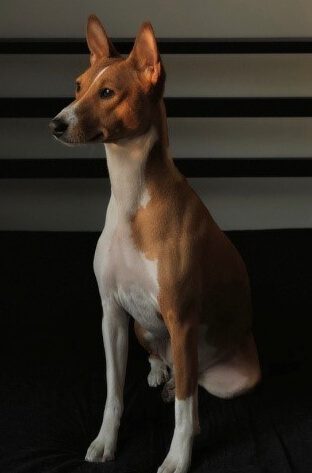
If we then finally look at some other breeds made for extreme climates, we have basenji, which was developed in Central Africa with a temperature around +25-28 C. They are small, with short, fine guard hairs and almost no undercoat. Again, they are adapted to heat with their small body mass and almost no undercoat that insulates them.
(Photo by Edvinas Bruzas on Unsplash)
They are part of a group of breeds labelled as “pariah dogs” or “primitive dogs,” originating in Africa, the Middle East, South Asia, South Europe, and Latin America.
They all share the same body type but differ slightly in size and coat thickness depending on the average temperature in the area they are from.
There are, of course, more breeds with coats adapted to their purpose, but I have chosen to focus on those mainly adapted to weather conditions to keep the text from being too long.
If you move a dog from its original climate to a completely different climate, you will, over time, see the body adapt to the new surroundings and the coat change. It doesn’t happen overnight, but a dog made for a warm climate will, after several years of living in a colder climate, have a different type of coat than when it first arrived.
( Shield 1972 –studies of dingoes moved to a cold climate)
All these breeds were fine in their natural habitats until we started to move them around – we brought Arctic breeds to hot climates and dogs made for hot climates to cold areas. And we started to “develop “them. With dog shows came an urge to change and exaggerate them, usually by adding more hair…….
If we look at pictures of long-haired collies from when the breed first evolved to how they look today, we can see that they have twice as much hair now. But their thermal regulating system is still the same. The system will only change if we let evolution rule – only the ones that survive will be able to breed. But modern breeding allows for the weaker individuals to produce offspring, and there is, therefore, no need for adaptation of the system.
And with the habit of altering hormonal influences on the coat through neutering, we interfere even more with nature’s way of dealing with heat/cold. Neutering alters the coat’s structure and thickness, and many neutered dogs carry excess weight.
So if man had let the breeds stay in the climates they were made for and we hadn’t interfered in evolution through dog shows and neutering – then this discussion about the right or wrong of clipping them would never have arisen…
Moving on from this – let’s see now how nature has intended the coats function in the thermoregulation process.
Dogs generate heat internally through metabolic heat production. The internal body temperature is independent of the environmental temperature, as the thermoregulating systems always keep it around 38C unless the system is put under hard pressure.
If it is cold or hot, the system needs to work harder, which will strain the dog in the long run.
One way dogs gain heat is through muscular use,if the dog is moving around, inner heat is created through the energy released from the muscle movement. Muscular movement creates heat that is also released for a time, even after the movement has stopped. This makes exercise a high-risk factor for heat stress, and it doesn’t matter if the dog is long or shorthaired.
(Investigating factors affecting the body temperature of dogs competing in cross country (canicross) races in the UK Anne J. Carter⁎, Emily J. Hall)
The coat’s main function is to prevent heat loss and protect the skin. The coat changes throughout the season to adapt to the environmental temperature.
All animals change between summer and winter coats. We can read in Korhonen H., Harri M. & Asikainen J., 1984: Moulting and seasonal pelage variations in the raccoon dog. Acta theriol., 29, 7: 77—88 how the coat goes from shorter and thinner in the summer to longer and thicker in the winter.
The change allows for an effective heat loss during the warm period and effective insulation during the cold period.
There are 3 different ways in which the coat is involved in the heat loss/gain/preservation convection radiation conduction
To explain it in simple terms
Conduction is when the heat is transferred from a hot solid object/non- moving fluid (still air is considered a fluid ) to a cool solid object/non- moving fluid in direct contact with each other.
Convection is when the movement of air removes the heat from a warm area to a cooler area
Radiation is transfer of heat from an warmer object to a cooler by infrared radiation without direct contact.
The coat is also indirectly involved in heat loss through evaporation—this is when heat leaves the body through fluid. In this case, it’s heat loss through fluid leaving the skin.
But very little heat leaves the body this way—the primary heat loss through evaporation is done by panting. Panting is the most important part of the heat loss process once the environmental temperature reaches a certain degree, but I won’t talk about that now as the coat is not directly involved in that.
(Read more in the book Ecological and environmental physiology of Mammals by P.Withers, C.Cooper, S.Maloney, F.Bosinovic,A.Cruz-Neto )
The total heat loss/heat gain is a combination of all of them – we can’t just look at one and draw a conclusion based on that number. A dog can, for example, have a thick coat and gain heat from environmental high temperatures -but at the same time lose heat through conduction to a cooler surface that it lies on due to a shaved stomach. And then top it up with a wind that increases the heat loss through convection
This is why simple formulas like Newton’s law of cooling aren’t applicable when we discuss this subject as the parameters are different. (A Heat Transfer Analysis of Animals: Unifying Concepts and the application of Metabolism Chamber Data to Field Ecology, G.Bakken)
Klein writes in 2012 “The body temperature is dependent on a balance between heat inputs from the internal and external environment and heat outputs. The ambient temperature will determine the heat input from the external environment. If the ambient temperature exceeds the body temperature, the dog will absorb heat from the environment .”
Conduction happens in two ways in the thermoregulating process.
1) When the dog’s skin is in contact with a surface/non-moving fluid (such as air ) that is cooler/warmer than the dog’s body temperature – heat loss will occur if the dog lays on a cool surface like tiled floors or fresh grass. If the surface is warmer than the dog’s core temperature – the dog will instead GAIN heat from it. Warm concrete will heat the dog in the same way as a heating pad for example.
This is the main way conduction affects thermoregulation in dogs.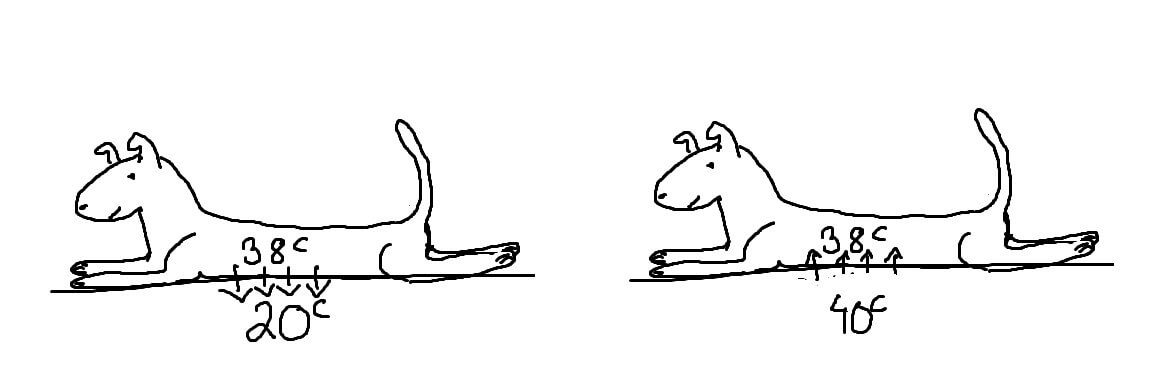
The first dog is lying on a surface cooler than its body, which will transfer heat from the body to the colder surface. The second dog is lying on a surface warmer than its body, which transfers the heat from the surface to the body.
Conduction will also happen within the coat –heat from warm air within the coat will move to areas where the air is cooler.
The insulative value of the coat is more a property of the air held within the coat layers rather than on the coat properties it selves – but some heat is transferred up thru the coat by conduction along the hair shaft and that conduction varies depending on the hair quality.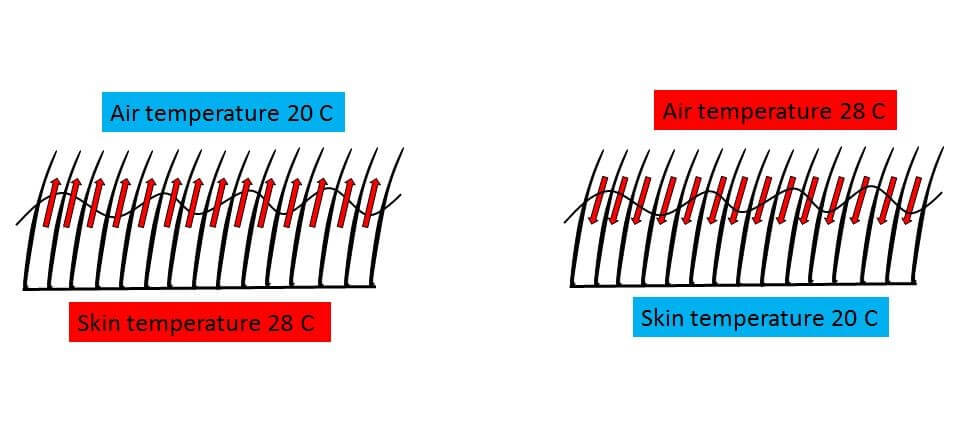
The first picture illustrates how it looks when the air close to the skin is 28 C- and the air further out in the coat is 20 C – the heat from the warm air will be transferred to the area with cooler air and heat it up. The air close to the skin will then decrease in temperature unless radiation from the skin reheats it.
The second picture shows the opposite situation—the air close to the skin is 20 C, and the air further out in the coat is 28 C. The heat from the outer layer will now be transferred down to the cooler area close to the skin and heated until the temperature in this area reaches the same temperature as in the outer layer.
Once the temperature in all layers is the same, the heat transmission will stop.
This is how the law of conduction works if you don’t have any barriers that prevent it.
How is the coat preventing heat loss through conduction? :
Air is trapped in a layer of still air close to the skin thanks to the undercoat – the thicker/denser the undercoat is – the more still the air is. This will prevent heat from leaving the coat, and the thickness will prevent cold air from being transferred down into the coat, as still air is a very effective barrier/insulation. Increased thickness of the coat reduces the conductive heat transfer according to Berglund 2009
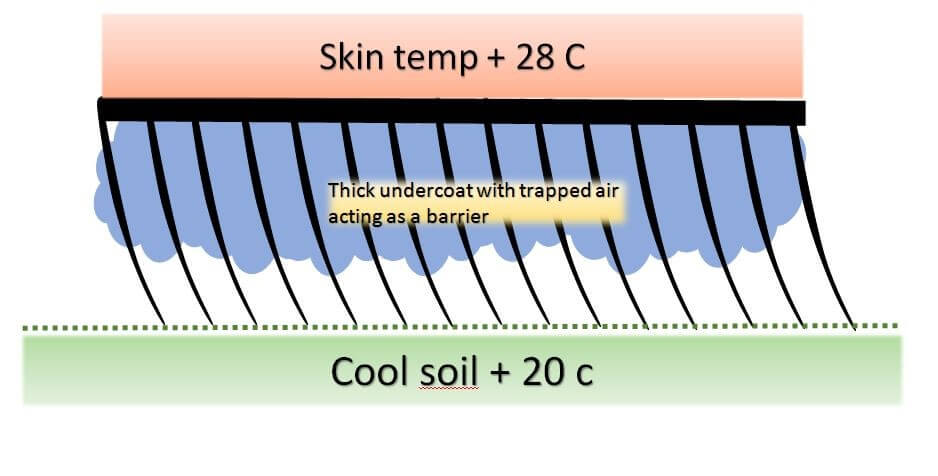
The coat’s main purpose is to keep the heat inside the body, so there are only a few so-called “thermal windows” on the dog that allow for direct conduction to the ground. Those are areas where the coat is thin so that heat transfer is made easy. They are the pads, the stomach, the armpits, the legs, and the ears.
When it’s cold, the dog curls up so that those areas are not in contact with the ground, and no heat transfer occurs. But when it’s hot, the dog lies flat so that the thin-haired areas are in direct contact with the cooler surface, and heat can be transferred.
Conduction is usually considered the less important mechanism for heat regulation due to the limited parts of the body that are affected on animals like dogs.
How is the coat preventing heat gain thru conduction? :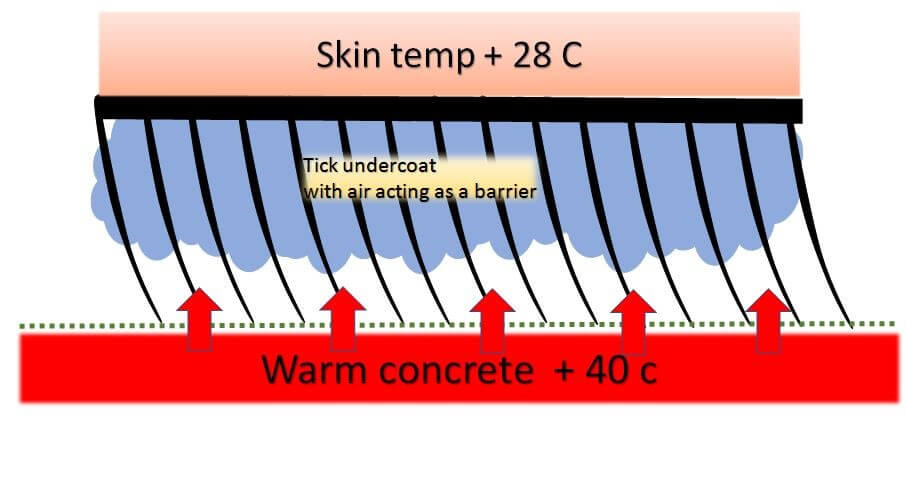
A thick layer of hair prevents the direct transfer of heat from the ground to the skin – but the heat from the ground will heat up the coat surface and that heat will then be transported deeper into the coat. But the direct heating will be delayed compared to direct contact between the skin and the ground.
Once the temperature at the surface of the coat is higher than the temperature close to the skin heat will be transferred TO the air layer at the skin and then onto the skin as the rule for conduction is that heat will go from the hot area to the cold one. But that will take longer than the direct transfer that will occur when the skin is in direct contact with the ground.
Radiation:
When the thermoregulation systems detect that the core temperature is rising, they send a signal to the brain that it’s time to get rid of some of the heat in the body. That is done by the heat being transported through the blood to the skin’s surface. The heat is then released into the skin, radiating into the cooler air that is trapped close to the skin inside the coat.
Once that has happened – convection and conduction take place and continue to move the heat away from the body.
A major obstacle for heat loss through radiation is fat. Fat is a poor conductor of heat – so if the dog has a thick layer of body fat -a lot of the heat will be stored in the fat instead of radiating out from the skin.
Nature has used this to its advantage when creating animals that live in cold climates – they have a thick layer of fat that insulates and prevents heat from leaving the body. And the opposite is done for animals that are created for hot climates – they have very little body fat to make sure a maximum amount of heat is evicted thru radiation. (Do you remember the sighthounds from desert areas – they have very little body fat – but wolfhounds that are also classed as a sighthound but originate from a colder climate have a completely different body type)
When we allow the dogs to go fat we disturb the thermoregulating process. The body won’t be able to release excess heat through radiation and that puts a bigger strain on the other heat release systems in charge. Systems that use more energy to work – and a by using the energy they also produce heat….
If the dog is old or weak from any type of health issue they may lack that extra energy that is required, and their body will also suffer quicker from the excess heat than a young healthy dog.
The coats role in heat gain through radiation:
The dog can gain heat through radiation from an object that radiates heat. Normally, that is the sun or a radiator. As we can control the heat coming from the radiator, I will only discuss radiation from the sun.
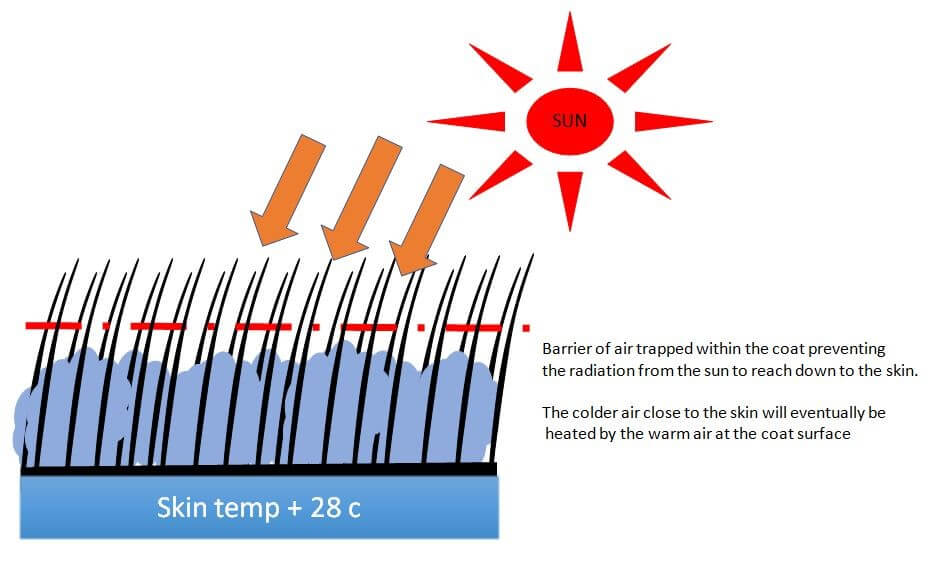
Solar Heating of Mammals: Observations of Hair Transmittance by N. A. 0ritsland and K. Ronald tells us that 70% of the solar radiation heating at a wind speed of 0.5m/s is down to coat length – the longer the coat is – the less of the heat is transported down to the skin. Only a small amount was down to reflection.
(They only measured how much heat that the hairs were able to transport down to the skin – not how much that was stored inside the coat.)
Dawson,Webster,Maloney concludes in their paper The fur of mammals in exposed environments (2013) that a really thick well insulating coat restricts the heat flow from solar radiation and that the impact of coat colour is negligible. (The general rule is that dark colour absorbs more heat than light colours) However –when the coat insulation decreases colour increasingly influences the heat inflow from solar radiation.
So both of the papers show us that a longer coat delays heat gain from direct sun radiation. It won’t prevent it as once the outer layer of the coat is heated by the sun -conduction will occur and heat will be transferred down to the cooler air closer to the body – but it will be delayed.
We also learn that when the coat gets shorter or thinner the solar radiation will heat up the body quicker if the coat is dark compared to a light coat.
The coat’s role in heat loss through radiation:
A thick undercoat will form an isolative layer that captures the heat radiating from the body and prevents it from leaving the body.
The thicker the coat, the more still air is trapped within it, and the more heat is retained within it.
A study by C-J Chesney, done indoors on 6 Landseer-coloured Newfound lands (The microclimate of the canine coat: the effects of heating on the coat and skin temperature and relative humidity C. J. CHESNEY ), showed that heating the outer layer of the coat led to an increased temperature within the coat and a raised skin temperature.
The mean skin temperature started out at 35 C and the mean coat temperature was 28.5C. The room temperature was 23 C. After 25 minutes of heating from the infrared lamp the mean skin temperature was now 39.4. The mean temperature within the coat was now 40.9 C.
The radiation from the infrared lamp had heated the surface of the coat and the heat was then transported down into the coat through conduction – heat is transferred from warm areas to cold.
This lead to an increase in the coat temperature and you can see that the difference between the coat temperature and the skin temperature is only 1.5 degrees compared to the start when the skin temperature was 35 and the coat temperature was 28.5. At this point, heat is going DOWN to the skin and heating the dog.
They also measured the skin and coat temperature on 9 black and white border collies that was outside playing on a sunny day with an environmental temperature of 21 C.
The mean skin temperature on them was also around 39 C – and the mean coat temperature was 38.5 C.
The difference in the coat temperature can be contributed to wind convection on the outdoor dogs and due to the difference in between the coat characteristics- length/thickness
We can see that even though the environmental temperature is only 21C, the temperature inside the coat is 38.5, which shows that the coat doesn’t catch cold air. If radiation heats up the outer layer of the coat, that heat will be transferred down into the coat after a while.
If the dog moves around some of the heat will be released thru convection.
Convection – is the transfer of heat due to the movement of air. There are 2 types of convection: free and forced.
Free convection occurs when the heat that is radiating from the body heats up the air close to the skin- the warm air then raises away from the skin.
Forced convection is when an external force moves the air – like wind or you are moving your hand through the coat or when the dog moves, and the hair is moving due to that movement.
Free convection plays a small role in the total heat transfer while forced convection can have a great impact on it.

A so-called “boundary layer” develops at the surface of the skin and throughout the coat. The layer starts at the skin, where the air temperature is the same as on the skin, and it ends above the coat surface, where the air can mix with the air that surrounds the dog and reach the same temperature as the environment.
In fancy wording – Convection is conductive heat transfer through the boundary layer.
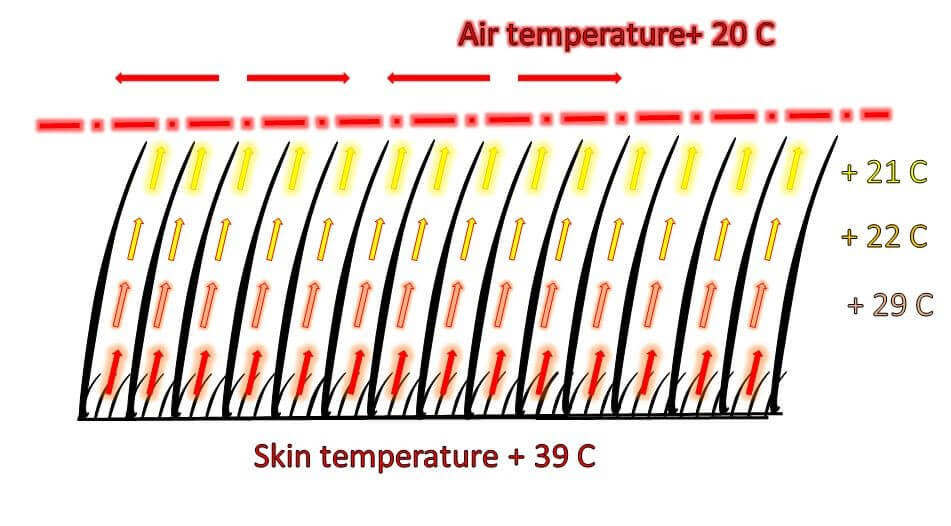
If the undercoat is thick and a large amount of air is trapped within it, less heat will be transferred through it, as air is a bad conductor of heat.
If the air temperature is higher than the skin temperature heat will be GAINED by convection (stockman 2006) –so the coat can’t “catch” cold air if it’s a warm day.
The body temperature will also increase on a hot day as the dog breaths in warm air that heat it from the inside.
A lot of things affect the heat transfer through the layers – the thickness of the coat-the length of the coat – the shape of the dog/area the heat is radiating from, the difference in the temperature within the layers, winds that blow through the coat – how strong it is and from what angle is blowing, the dog’s movement and more….
There are equations made up where you can predict the heat loss through convection -but as there are so many factors that you have to consider -the equations are just a theory and you need to do a “real life” experiment to come to a more accurate conclusion for each individual case.
A dog can regulate the thickness of the still air layer by raising the guard hairs so that there is room for more air within the coat.
Breeds developed in artic areas already have a coat that allows for maximum air layer as their guard hairs and undercoat is already standing straight out from the body and the undercoat is very thick/dense – this shows how nature has adapted the coat to the environment – the body doesn’t need to use vital energy to create the shield – it is already there.
Breeds from areas with a mixture of warm and cold climates have flatter coats, and they must make a larger effort to raise the guard hairs when it’s cold and lower them when it’s warm.
Raising the guard hairs raises the insulation layer, but this is partly offset by the coat’s greater openness. This more open hair layer loses more heat because of increased wind penetration and subsequent convective heat loss. So, it’s not that effective if there is a strong wind present, especially if the undercoat is thin.
Approximately 95% of the volume of the hair coat is occupied by entrapped air and this greatly affects the insulation of the coat (BIANCA, 1968).
Convection has important consequences for the heat exchange – if, for example, the air temperature is lower than the skin temperature, an increase in the wind speed will make the coat move more and more heat is lost through the boundary layer inside the coat. That will lower the skin temperature and give a signal to the body to either produce more heat if the skin temperature goes below a certain degree or stop the heat radiating from the skin if the skin temperature is a correct level.
The coats role in preventing heat loss from convection:
The dog’s coat reduces heat loss by trapping a layer of still air close to the skin (still air is one of the best insulations available as it’s a poor conductor of heat) The more dense and thick the undercoat is – the more air is trapped within it and more heat is stored – it’s also harder for the wind to get into the thick dense coat.
The longer the coat is – the harder it is for the wind to reach in and release the heat.
Increasing the hair coat depth increases the boundary layer which in turn increases the amount of air trapped within the coat.
The higher the environmental temperature is – the less heat is lost through forced convection/wind as no transfer occurs. (If the temperature within the coat and the environment are the same there won’t be any transfer)
One theoretical study showed that by increasing the coat length from 1 cm to 2 cm the heat loss dropped by 80% at a windspeed of 1m/s. For a 20 mm hair coat depth, increasing wind speed by a factor of 10 increased heat loss by 58%, but for a 30 mm hair coat, heat loss increased by only 14%. – so the longer the coat is – the less heat is lost through convection (A MODEL OF SENSIBLE HEAT TRANSFER ACROSS THE BOUNDARY LAYER OF ANIMAL HAIR COAT K. G. GEBREMEDHIN )
The higher the wind speed is – the more important the coat thickness is to prevent heat loss according to Tregear´s study from 1965 – The heat loss from the skin of a naked pig was I0 times that from a rabbit skin with hair on in strong wind – while in still air the ratio was only 4.
The coats role in preventing heat gain through convection:
Despite popular belief among dog groomers, the coat is NOT catching cold air. The air that blows through the coat releases hot air trapped inside it, reducing the temperature inside it. However, no heat exchange will happen once the environmental temperature and the coat temperature are at the same level.
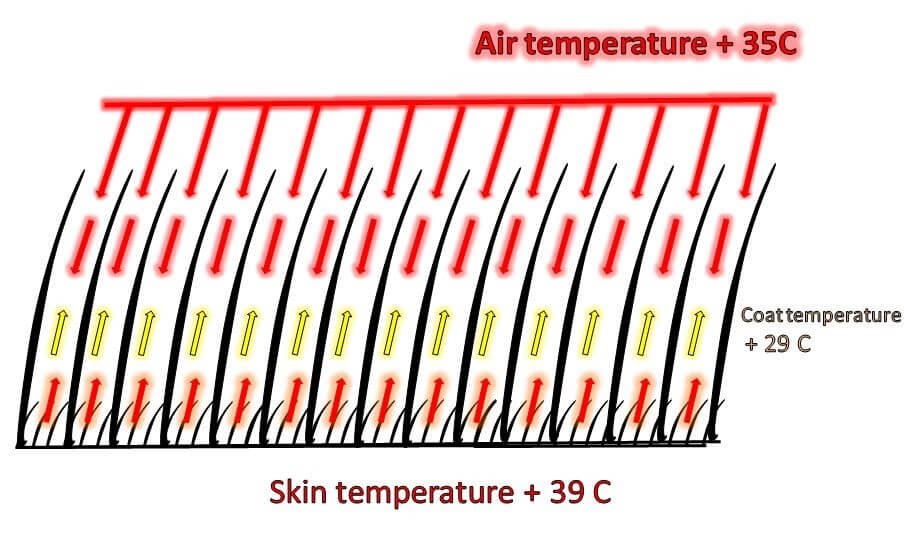
The picture shows how the temperature inside the undercoat is 39 – the heat is then transferred up towards the colder part of the coat and decreases. But when the air temperature is 35 the heat from the environment will now be transferred down INTO the coat towards the area with the lower temperature – reheating it.
Evaporation through the skin: Heat loss by evaporation from the skin depends on the difference in temperature between the skin and the surrounding air. The rate of evaporation will depend on the air movement. If the air close to the skin is still, the air quickly will have the same temperature as the skin, and no transfer will occur. If the air is exchanged, more evaporation will occur as the air continues to be cooler than the skin if the environmental temperature is lower than the skin temperature.
When you have a dog with a long thick coat there won’t be that much evaporation through the skin as the coat will prevent the exchange of air and therefore keep the air temperature close to the skin at a high level.
If you on the other hand have a dog with a short thin coat and areas without or very little hair the exchange of air will be much bigger, and more heat (and moisture) will be lost this way.
When the effective environmental temperature is equal to or greater than body temperature, evaporative heat loss is the only kind of heat loss possible. Evaporative heat loss is now done by panting rather than through the skin—the warm blood heats the tissue inside the nose and mouth, evaporation occurs, and heat is transferred out from the body.
Radiation, conduction, and convection contribute to an increase rather than a reduction in body temperature in a warm environment as the heat is going down in towards the body rather than away from it – this is important to remember! (Hahn, 1994;Fuquay, 1981). However, if the relative humidity is also high, evaporative cooling is less effective (Hahn, 1994; Fuquay, 1981; Mount, 1979) and the risk of heatstroke increases rapidly.
So, what conclusions can we draw from all these studies/scientific facts that I have listed regarding the discussion about whether we should clip a dog in warm weather?
Again, we must first and foremost remember that all breeds have the same thermoregulation. There is no difference between a poodle, a golden retriever, or a short-haired Jack Russel.
So everything that we have found applies to all of them.
There are breeds that have become more heat tolerant through evolution, but they still have the same thermoregulating system.
All breed types have a coat/body shape that is adapted to the environment they originally lived in. Humans have then altered the coats on many of them to become longer and thicker to please the eye and we also alter the properties of the coat by neutering.
By moving the dogs from the environment, the coat originally was adapted to – we force them to deal with climates they are not meant for. And the coat’s initial purposes can suddenly be a burden instead of an advantage.
This has impacted their possibilities to regulate their body temperature in the way nature had originally intended.
If we in this discussion only focus on the role of the coat in the thermoregulation process – not its protective properties from damage to the skin or the fact that negative changes can occur to the coat when it’s clipped on certain coat types – the following can be concluded:
– The coats main function is to PREVENT heat loss. The thicker and longer the coat is – the better isolative properties AGAINST heat loss.
There is a direct correlation between coat length and thickness and the coat’s ability to KEEP the heat within it when you apply a wind. The thicker and longer the coat is – the harder it is for the wind to penetrate into it and release the heat that is stored within it.
Berglund .et.al 2011 did a computerised model that showed that a short clipped dog tolerated heat better than a longhaired dog in the absence of convection by wind.
Studies, literature reviews, and field trials on animals with the same type of thermoregulation and the same type of coating all conclude the same thing :
– The shorter the coat is – the easier it is for the animal to release the heat from the body
– The thinner the coat is – the easier it is for the animal to release heat from the body
– Less wool/undercoat reduces the coats ability to store heat
Direct heat gain from solar radiation can be delayed by a thick coat – but a high environmental temperature adds to the thermal burden and the heated air on the surface of the coat will eventually heat the air inside the coat. By having the coat shorter – heat will disappear easier due to the air movement within the coat.
UV rays from the sun can cause irritation to the skin – by leaving a short protective layer that problem can be avoided.
So, if we only look at hot weather it’s beneficial to be clipped – but we need to leave a protective layer for the skin to avoid damage from UV rays.
But if it’s cold and wet – then it’s not beneficial at all to be clipped short.
Water breaks down the boundary layer inside the coat and the insulative air layer will be destroyed and the heat within the coat will now leak out and cold wind can get down directly to the skin as the coat is left open by the water.
This means that we must either plan for winter when we clip – as in giving the coat plenty of time to grow back – or make sure the dog has proper protection from the elements when winter arrives.
This won’t be a problem if you have a breed that has a coat that isn’t affected by clipping. But the so-called double-coated breeds might have a delayed re-growth or no re-growth at all – and you are at risk of having a dog with a short or sparse coat when winter arrives.
If you live in a country with mild winters and the dog is living indoors you don’t really need to bother about it – but if the dog is living outdoors or you live in a country with cold winters – then you need to weigh in the benefits of the short coat during the summer with the risks of lack of protection during the winter.
You can always put a jacket on the dog if it’s cold or wet and windy to replace the shield the coat is supposed to give the dog. But we need to be aware that a jacket can have a negative effect on the environment within the coat/skin if left on too long.
We can also do an “in-between” if it’s a double-coated breed – instead of clipping the coat short all over the dog – leave the coat in its natural length on the upper part of the body – but clip the stomach/chest and armpits short. Make sure that you de-shed the dog so there is only a little undercoat left that can form that insulative layer that keeps the heat.
That will make the “thermal window” larger and it is easier for conduction to occur to the ground. You can even clip it shorter under the chin and down on the throat. That is an area that is naturally shorter in many breeds.
This can work well for dogs that are not overweight and don’t have a reduced thermal regulating ability due to age/health.
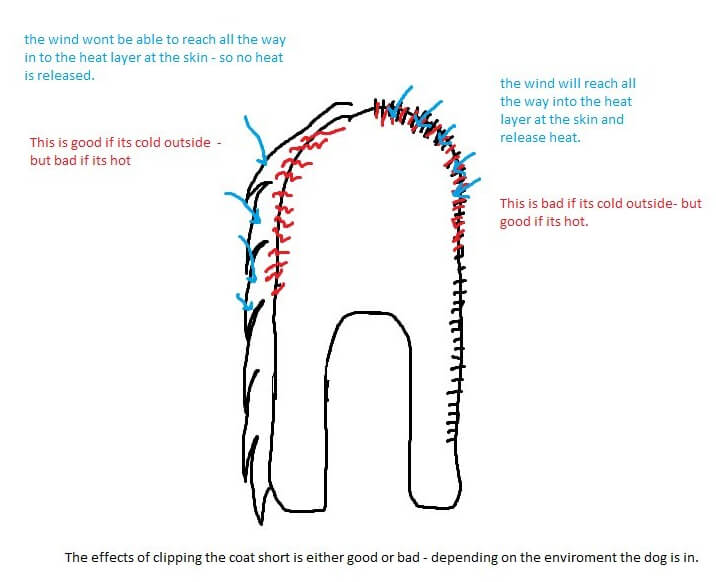
Long hanging guard hairs and thick undercoat act as a shield against rain and wind.
The long guard hairs prevent the wind from getting down into the coat and release the heat.
This is great if it’s cold and rainy – but if it’s hot and no wind the dog will quickly become heated as the high environmental temperature will heat the air inside the coat and the thick coat will prevent the heat from leaving it.
The other side of the dog is clipped short – this is beneficial if the air temperature is high – the heat from the body can now instantly disappear. The heat will now disappear quickly from the body as there is no coat that prevents it from leaving.
If there is a slight wind the radiation from the sun won’t be a problem either as the heat is quickly blown away by the conduction of the wind.
BUT….. If you have a low air temperature there is nothing that prevents the heat from leaving the body. And if it rains the water will quickly get down to the skin and chill the dog and if it’s windy the cold wind will instantly get down to the skin and release whatever little heat that is present.
This shows that both sides have their pros and cons and you need to determine what is most beneficial for each individual dog that you see and its circumstances – body condition, living conditions, general weather conditions, and more.
There is no black or white 😉
Mia, may I put your two articles into a PDF to make them easier to share withing dog groups? With proper URL links, your name, titles of the articles, etc. This is the best researched article on the topic I have ever found.
Hi Laurie!
No problem – as long as I get the credit I am fine with you sharing it 🙂
Pingback: To shave or not to shave – a look into the literature about dogs thermal regulation,coat growth and more…… – MY HAIRY UNIVERSE
Thank you so so much for both articles on this issue.
Pingback: Clipping the dog short for the summer - MY HAIRY UNIVERSE
Pingback: The short version of my previous post on how a long coat affects a dog when it's hot outside - My hairy universe
Pingback: Termoregulacija pri psih | V pasji družbi
This is all interesting to me from a scientific, physiological perspective. At the same time, I wonder how many people really need to worry about this issue. My dog and I live in an air-conditioned home. It is always 20 degrees Celsius for us. During the heatwaves, we only go out in the early mornings and evenings, when it’s 20 degrees. So, when people criticize me for not clipping my golden doodle, but just brushing him daily, because of the warm weather, I think that they’re inventing a problem that doesn’t exist.
As thermoregulation is a complex system, we cant apply a cookie cutter approach to it. There are so many factors you must weigh in.
Some dogs can deal with heat without a problem if you have sensible approach to it as you do- temperature controlled housing environment,making smart choices on when to exercise the dog and so on.
But others are affected by it due to health issues, age, overweight or just a general heat intolerance.
My previous standard poodle had a super thick coat and was affected by the mild heat we have here in Ireland🫣
The minute we got more of a warm weather – I would have to clip him short all over or he would be panting and be general uncomfortable.
While my foxterrier spends her days in the sun and would sleep on top of my stove if I allowed her.
So you are completely right in that its unnecessary to clip all dogs short just for the sake of it ….look at the individual and make a decision based on that dogs needs/circumstances.
As a groomer I very much appreciate this article. I have had the old “the double coat keeps them cool by trapping cool air against the skin” bs regurgitated to me by other groomers, clients and in countless articles by pet wellness companies and so called experts that offer exactly zero proof of this illogical statement. I do not advocate for shaving double coated breeds due to the potential damage to the coat but if a client tells me their dog is too hot i am not going to gaslight them by telling them a thick long coat actually keeps them cool. It’s just absurd, and yet so many believe it and repeat it. And I guess I cant even blame them because it takes real determination to search for and find any factual information.
So thank you again for gathering these facts, I can now better explain the coats role in thermoregulation.
I am glad you found it helpful ☺️ I was taught the same as you, but when I started to work as a veterinary nurse, I had to “unlearn” the myth.And once I started to teach canine physiology at an animal care college, I had to start gathering the science to be able to explain it better to my students.
But you sometimes despair when groomers point blank refuse to embrace the science – “because they know better”🙄 Even if you present data from people with a PhD on the topic and 20 years research behind their data …..
Pingback: The Chiengora Opportunity: A Comprehensive Market Analysis and Monetization Strategy for Dog Hair Fiber - Ask Deep Research