Shih tzu coats and heat

May
I got an interesting question from a Shih Tzu fancier:
“Can the Shih Tzu breed coat tolerate warmer climates? In particular, how climate can affect the long-haired show dogs. Particularly given that the Shih Tzu coat type is somewhat different to the average double-coated breed because their coat consists of minimal shedding hair rather than fur..”
Let’s dive into it ☺️
If we start with the breed standards description of a Shih Tzu coat :
The UK Kennel Club and FCI ( the European Kennel Club Union) say the outer coat is long, dense, not curly, with a moderate undercoat, and not woolly.
AKC( American Kennel Club): Luxurious, double-coated, dense, long, and flowing.
The Swedish breed club advises judges that the coat should be long and thick, with an undercoat and shiny guard hairs.
The American club says in their comments on the breed standard:
The Shih Tzu undercoat should be soft and dense, and the outer coat should be somewhat more complex and perhaps lay flatter than the undercoat. A single coat refers to a coat without the desired undercoat present.
So we definitely want a “double coat”. But we don’t want it to be a long, woolly undercoat, much more a straight, shorter undercoat that doesnt lift the guardhairs.
However, the Shih Tzu coat has changed throughout the years. If we look back at images of Shih Tzu 100 years ago, they did not have the same lengths in the coat as we see today in the show ring, and the coat structure was harder.
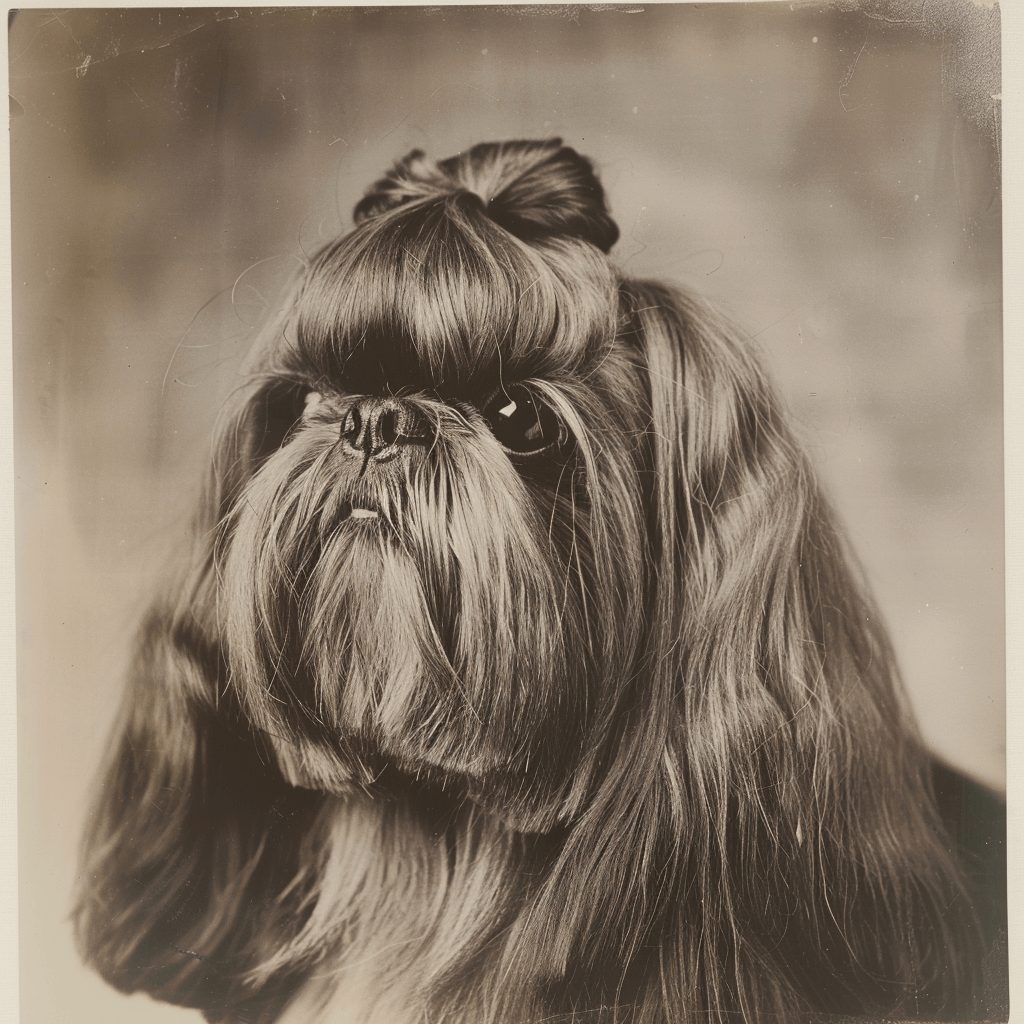
The old coat type is well described on the American Shih Tzu clubs website :
“These coats had a strong top coat that could tolerate a lot of abuse and a non-woolly undercoat that did not mat if you looked at it cross-eyed.”
We must breed for softer guard hairs to get the fantastic coats we see in the show ring nowadays.
This creates a coat that is more sensitive to damage but also mats more.
And that can also cause an issue when it comes to the dogs heat tolerance.
An article by Bossma from 1949 concludes that a softer, woollier coat that felts/mats makes it harder to dissipate the heat inside the coat. (this has been established later on as well)
Looking back at older images, we can clearly see the strong, shiny guard hairs,
(As the rules for blogs to share images without specific clearance from the image owner are strict -here is a link to an image on the AKC website. Don’t be afraid to click it.)
Vintage shih tzu image AKC webpage

The original coat matted less as it had stronger, shinier guard hairs and thicker/stronger undercoat hairs, clearly defining the two hair types that allowed for better heat dissipation and less matting.

A thicker hair shaft makes it easier for the heat to dissipate. A shiny hair shaft can also help reflect the sun’s rays away from the dog.
It is also well established that the thicker the coat, the harder it is for the heat to dissipate, and the longer the coat, the longer it takes for the heat to reach the surface.
However, thickness is the main issue regarding heat tolerance, especially the thickness and texture of the undercoat. If the undercoat is thick, dense, and slightly “crimped, ” it stores more air, which means more room for the heat.
The coat colour is also interesting. A black coat absorbs heat better than a white coat. However, a white coat reflects sun rays deeper into the coat, causing burns on the skin unless it is dark pigmentated.
The benefit of the black coat is that the heat stays on the surface and can be removed by convection(wind), but the heat added to a white coat goes down to the skin, making it harder to escape.
Its established on other species that red is the ultimate colour when you live in a hot dry climate,and that seems to be the case for dogs as well if we look at breeds that are from that type of climate.
If we look at coat length
A long, thin coat is no issue if it is windy, as the wind will remove the heat.

If you live in a dry climate with no wind but high environmental temperatures, the long coat will be a disadvantage as it will take longer for the internal heat to dissipate.
If you have a short white coat, the risk is higher for skin irritation due to sun rays, so shaving them close to the skin is not advised.
When it comes to the show coat, it’s a case of looking at the individual.
We know that a long coat adds to the heat burden, but only to a certain extent. According to a paper by M. Jiang, K. G. Gebremedhin, and L. D. Albright (2005), the main factor is thickness/density.
On the one hand – if you band up the coat all over the body, the parting of the coat will allow heat to dissipate from the skin in all partitions. On the other hand, the same procedure will also reduce the airflow through the coat as the banding holds the hairs together, preventing the heat from disappearing in that area.
And I can’t really say if one thing weighs up for the other…..My gut feeling is that banding won’t add to the heat burden but actually help. But it will also open up for the sun to reach the skin, so be careful so the dog doesn’t get sunburnt in the partition areas.
Clipping the dog short, down to the skin, under the belly, and out under the chest will help increase heat dissipation on show dogs, especially if they are banded, as that opens up more airflow under the stomach where they have a heat dissipation window.
Do not put an “anti-scratch” jumpsuit on the dog to protect the banding, as that will prevent heat dissipation and create a warm bubble around the dog.
Ultimately, it’s a combination of environmental factors, the dog’s physical appearance, and the individual dog’s heat tolerance.

It is not just the coat that can affect the dog’s ability to keep cool.
- Body fat. Fat prevents the heat from leaving the body, acts as insulation, and prevents the inner heat from reaching the skin surface.
This means an overweight dog with a thin coat can be hotter than a slim dog with a thicker coat. - Age: When the dog ages, its thermoregulating system is less effective. This makes older individuals more sensitive to heat.
- Medications: Some medications affect the dog’s ability to regulate its body temperature properly. If your dog is on any medication, read up on its effects.
- Temperament: A dog with a high-stress level produces more inner heat, adding to the heat burden.
- Physical activity: Any movement increases the amount of inner heat, sometimes up to several hours after the activity has stopped. Hence, it’s important not to exercise or let dogs participate in intense exercise when it’s hot outside.
- The head shape: A short nose makes panting less effective, as less tissue surface reduces the heat exchange.
My advice would be to look at each individual dog.
If the dog is panting a lot, it needs to dissipate excess heat, and the primary way of doing that, radiation from the skin, is not enough. Now, it’s time to help the dog.
Panting is tiering and adds to the heat load as they use muscles. All muscle activity creates inner heat, and you end up in an endless negative circle.
The wider the mouth and the further out the tongue when dogs pant, the hotter the dog.
Clip the dog shorter if it has a thick coat, but don’t skin it. It is essential to leave some protection for the skin to prevent sunburn.
If the dog has a thin coat, making it shorter won’t have a considerable effect. But you can shave the tummy shorter to help with heat dissipation from that area.

Keep the dog out of the sun and get a fan. Air moving around will help to chill the dog.
You can also wet the dog, as the evaporation of the water will cool the skin, especially in conjunction with the air movement.
Don’t walk the dog in the heat; muscle activity will create inner heat for several hours after the walk and can cause a heatstroke later in the day.
As you can see, there is no cookie-cutter answer. Many factors weigh in, and that is why we must ultimately look at each individual dog and its circumstances when we make decisions.
If you feel that your dog is affected by the heat , clipping it shorter will help -but dont skin it 💖
If you have a dog that you are showing or just like to keep long, keep the coat, but make sure it’s well combed so that the hairs can separate and allow the heat to dissipate. And see if you can shave out the stomach and maybe a bit out on the middle of the chest- creating a window for the heat to disappear.
But be aware that the larger amount of coat will add to the heat burden and therefore demands more actions to mitigate the risk of heat stress.
When its the warm season of the year, make sure that your dog has shade and airflow and does not exercise during the warmest hours of the day. Keep it out of direct sunlight, as sun radiation adds to the heat load. ( the sun will also do damage to the show coat )