

Clipping the dog short for the summer-a look into the scientific literature
Jul
I wrote a long blog post in 2018 about clipping dogs short for the summer -especially so-called double coated breeds.
It took me one year to put it all together, and just past its fourth anniversary-in 2022, it has had over 100,000 views.
I never thought it would become so popular. My main goal was to have a page people could refer to in discussions about the subject.
Over the years, I have realised that some people find all the information a bit overwhelming, so I have decided to revamp it to make it more accessible. I have also updated it with new scientific papers released since I wrote the first post and others I have found during my research.
It is hard to shorten it as this is not a black and white subject you can deal with in a simple Facebook meme…..You need all the information to understand the complexity fully.
I have tried my best to make it a bit easier to digest the information – but I am sorry to say that it’s still as long – SORRY!
What I have done now is to have a summary at the start of each “chapter” in italic writing and then a more in-depth section for those who want to dig deeper into the subject. All references are in the in depth section. If you don’t want to read everything – just read the introduction for each section and skip the rest.
I have also written a “shorter” post that is more like a summary of all the facts
that you can access here if you feel that a long text will make you fall asleep
Let me know how you find it 😊
There is no easy answer and we can’t just base our decision on a Facebook meme.

So, what is right? Will they die from heatstroke if we clip them as we mess up their thermoregulation? Will they get burnt by the sun and get skin cancer? Are we causing them unnecessary suffering if we clip them? And will the coat be destroyed and never grow back again?
As a former vet nurse now grooming my world is ruled by scientific facts – not myths/old housewife tales – so I decided to dig into the subject from the scientific point of view – gathering facts produced by professionals rather than from various written pieces from laymen like dog rescues or Jane Doe that decided that they wanted her 15 minutes of Facebook fame.
I am going to try to explain how it works and then it is up to you as a groomer/owner to decide if you want to do it or not.
All my claims will be supported by information on where I found the facts so that you can check them out yourself. I urge you to do that—click on the link under the study and read it yourself—which will give you more information on the small details.
If the study is hidden behind a paywall, copy the long doi.org number under the paper’s title and paste it into www.sci-hub.se . This will give you free access to the paper.
Then, you will be able to make an educated decision based on proven scientific facts instead of asking on Facebook and getting someone’s view based on a myth passed down for generations.
The fact is that science changes as well – what was thought to be the truth 15 years ago could now be proven wrong with new facts emerging.
One thing that makes this subject so complicated is the fact that we must deal with 2 different factors—the physiology part, which clearly says one thing, and the dermatological part, which might say another thing depending on the coat type.
We must learn to separate them to start with in order to understand the subject better. Once we have knowledge of both factors, we can make a decision.
My take on this subject from the start was quite clear and black and white – but while digging into it I realized that is more complicated than I thought, and I had to review my standpoint a bit. It is not as easy as any of the side claims ….. it’s a complicated issue that depends on a lot of factors and this is why this piece is looooooooooooooooong……..

I have tried to use layman’s language to make it easy to understand even if you have no medical training. So grab your coffee and a box of chocolate and start to read—it is going to be a long journey …
Let’s start with that thermal image of the clipped golden retriever.
“A thermal picture shows how much heat is radiating FROM THE SURFACE of the dog- not the dog’s body temperature or how hot it is inside the coat ….. and it will, of course, be more heat coming from the short, clipped area than the long-haired one as the coat insulates and KEEPS the heat from slipping away from the skin.
It would be the same if you took a picture of a greyhound with a towel over its front—the area with the towel would display a lower temperature as the fabric would block some of the heat that you see on the bare skin.
But if you put the dog out in the sun, the radiation from the sun will heat the surface, and the temperature you see will now be much higher on both the bare and the covered areas. “
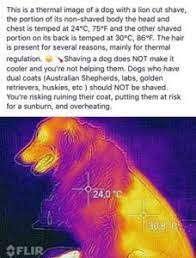
The picture showed that the coat was doing its job properly—it kept the heat from leaving the dog’s skin while the clipped area allowed heat to leave the body faster. It actually showed what the pro side says—clipping dogs keep them cool as it allows heat to leave the body.
And if you think about it, how can a dog have different body temperatures in various body parts? You can of course have different surface temperatures, but that doesn’t determine the core/body temperature.
Thermal imaging studies show that long-haired and double-coat dogs had lower surface temperatures. That’s because the heat inside the coat can’t get out onto the surface and, therefore, won’t affect the surface temperature.
Rectal temperature was not significant in evaluating differences in surface temperature. Showing that a thermal image wont tell you if a clipped dog is hotter than an unclipped dog. It only shows the difference in the surface temperature.
To learn more about how thermal imaging of dogs works -read these papers:
Mari Vainionpää Thermographic Imaging in Cats and Dogs Usability as a Clinical Method,2014 https://core.ac.uk/download/pdf/20441286.pdf
Quantifying body surface temperature differences in canine coat types using infrared thermography
https://www.sciencedirect.com/science/article/abs/pii/S0306456518305503
You can also read more on Wikipedia https://en.wikipedia.org/wiki/Thermography
Here is an illustrated explanation of the subject from Dr Melissa Starling:
” Thermal cameras detect infrared radiation and convert it into an image. Radiation increases with temperature, so these cameras can be a nifty tool for looking at temperature. However, they do not measure temperature per se. They measure radiation.
For example, the image below shows my short-haired dog, Kestrel, in a cool environment. At the time, Kestrel had a shaved belly due to her recent sterilisation surgery. You can see clearly where her hair is clipped because it is much warmer than the rest of her.

This doesn’t mean that it’s the hottest part of her. Other parts are covered in a thin layer of fur, which is enough to reduce the body heat she radiates, as it traps some of that heat against her skin where the camera cannot “see”. Her extremities are quite cool, which probably reflects her skin temperature compared to, say, her back, which also has a thin layer of fur.
The second picture is of Kivi in the same environment, who has a great deal of fur. His body has a lot of blues and greens, indicating he is radiating less heat than Kestrel.
This is the whole point of dense coats. His cooler coat does not mean he is cooler at this moment. It means his coat is doing a great job of trapping his body heat well away from the air, and not much heat is escaping from his body.

If the ambient temperature were much warmer, would this change his thermal image? I can’t show you an example, but yes, it would, to a degree. For example, if he stood in the sun, it would warm up his coat. Would that mean his skin and body were also warmer? Probably to some degree. We can see that some heat at least can escape his coat, so presumably, it goes both ways.”
( many thanks to Melissa for allowing me to use her pictures and texts. Visit her Facebook page about canine behaviour https://www.facebook.com/DrMelissaStarling/ )
Here is a video illustrating thermal images and how the temperature changes depending on coat length and sun radiation.
Now that the dreaded golden retriever meme has been debunked let’s move on to canine thermoregulation and the coat’s role in it.
For us to be able to make good decisions ,we need to understand the basics of thermoregulation and the coats role in it
How do dogs keep their body temperature at the right level?
Read more in Guyton and Hall Textbook of Medical Physiology.
Wikipedia
https://en.wikipedia.org/wiki/Thermoregulation#In_birds_and_mammals
Temperature requirements for dogs
https://www.extension.purdue.edu/extmedia/va/va-16-w.pdf
“ The system aims to maintain a core temperature of 38C, and if it starts to go above it or below it, different mechanisms kick in to either dissipate or gain heat. It’s like the heating system in your house. If the system fails to maintain the optimum level -damage will occur to the body, and in the end, death.
Heat is lost in the following ways :
Conduction: is when heat moves from a warm area to a cooler one. For example, a dog lying on a tiled floor . The heat from the dog’s body will move to the cold floor. This can also happen inside the coat when warm air moves to an area with cooler air.
Convection: heat is removed by airflow – the wind blows over the dog or the coat opens up by the dog’s movement, and the heat is released from the coat by the air movement
Radiation: heat radiates out from the object. Heat radiates from the dog’s skin.
Evaporation: when a fluid changes to a vapour – when the dog pants and when sweating from pads and skin. When the fluid changes to a vapour ,heat is lost .
Heat is gained from the environment, muscle movement and processes inside the body.
If the heat input is greater than the heat output, the dog is at a high risk of heatstroke or heat stress.
To make it short, at lower environmental temperatures, body heat is lost through radiation from the skin, and that heat is then trapped in the air layer between the coat’s hairs.
If it’s windy and the dog moves, most of the heat will disappear when the hair moves if the coat’s condition allows it. The longer/thicker the coat, the bigger the air layer, and the more heat is trapped inside it.
It’s harder for the warm air to disappear in a long, thick coat as conduction/ convection won’t reach down into it.
If the air trapped in the coat gets chilled, the system kicks in and produces more heat as the skin sensors react to the difference between the body and environmental temperatures.
The main heat loss is done by panting – panting is more important for the total heat loss, and the shorter the face is on the dog – the harder it is for the dog to lose heat this way.
Fat acts as insulation in both ways – it prevents heat from leaving the body and keeps the body warm when the environmental temperature goes down. “
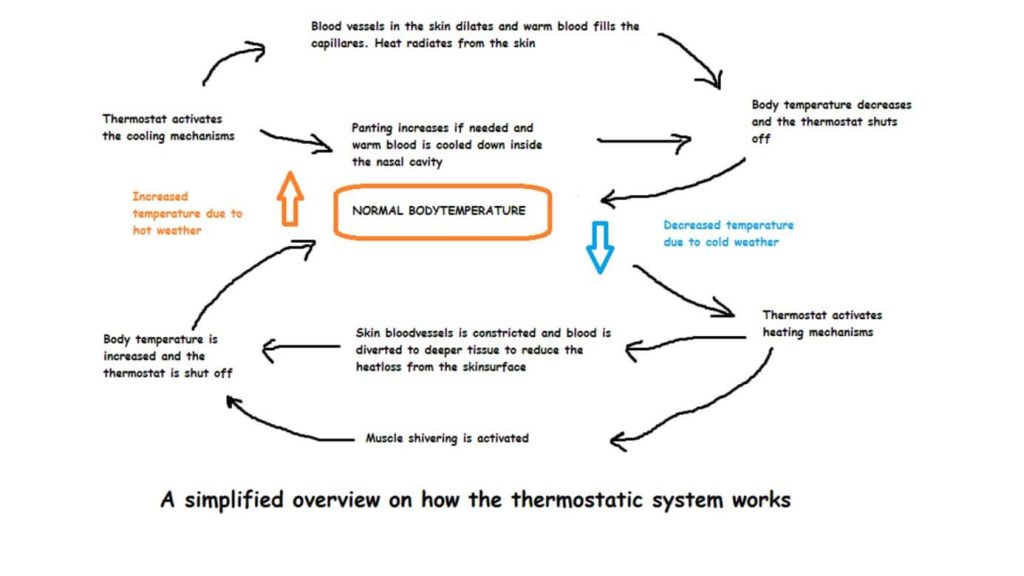
All warm-blooded animals have the same basic thermoregulation system—dogs, cats, hamsters, humans, birds….. the basic is no different. Once you investigate different species, you will see that adaptation has been done during evolution to adapt to different environments/circumstances. But within the same species, it’s all done in the same way—so there is no difference between different dog breeds, for example.
The body has an advanced system that is in charge 24/7 to keep the core temperature at the correct level. For dogs, this level is 38.5 ( +-0.5 ). When the temperature goes above or below that level, the system kicks in to restore it to the correct level – more or less like your average thermostat in your boiler system or AC unit.
This system is not fully developed in young individuals and is less efficient in old dogs – so they are more vulnerable to changes in the surrounding temperature – both heat and cold.
It’s essential to keep the core temperature at the correct level, as the dog’s body is made up of cells that contain a vital fluid known as protoplasm. This protoplasm contains proteins, vital nutrients, enzymes, and hormones necessary for life’s function. Chemical reactions necessary for life occur in the cells, and if the core temperature is too high or too low, those reactions will be altered, causing damage to the whole body and, ultimately, death as the system collapses.
Nature has put a great deal of thought into the anatomy of animals to adapt to their environment. For example, animals that live in cold environments are usually larger than animals that live in hot environments, as it’s easier to keep the core temperature at a correct level in a larger body volume in a cold environment and vice versa.
The coating of the body with feathers/hair is there to insulate, prevent heat loss, and protect the skin. The hair insulates and prevents the heat from leaving the body, and you see an example of that on dogs from cold environments—they have small ears that are very hairy, and on the opposite, dogs from hot environments have large smooth-haired ears to make it easier for heat to evaporate from the skin.

You can also see that animals developed for cold climates have thicker coats than animals from warmer climates. Some dog breeds developed in warmer climates might have a longish coat (but it’s thin) compared to breeds developed in cold climates.
They also set a thicker coat in the winter to increase the insulation.
“Many mammals increase their pelage in the winter season against the cold and increase the metabolic rate to meet the strong and growing thermal demands of their environments”
(HART, 1956, 1961; HERoux, 1963; HERoux et al., 1959; IRVING,1964; IRVING et al., 1955: SCHOLANDER et al., 1950).“Domestic dogs, commonly used as experimental animals in physiology, also increase the amount of their pelage when reared outdoors in winter. “
Seasonal Changes in Heat Balance of Dogs Acclimatized to Outdoor Climate https://www.jstage.jst.go.jp/article/jjphysiol1950/31/4/31_4_465/
_article/-char/ja/
We must also remember that we have changed the breeds to please our eyes throughout the years.
The No side somehow forgets this in discussions on the subject.
This means that we cannot categorically refer to nature’s plan regarding shedding, etc., in this discussion, as our breeding has changed the dogs’ coats so that they no longer function as nature intended.
We have also moved dogs made for cold climates (with attached extra-insulating coats) to warm climates that require thinner coats.
Nature had a plan for the dog’s coat, and if the coats were still the same today, as they were when dogs were created—and the breeds were still in their original environment—then we wouldn’t have this discussion…….
Its worded very well in the book -Hair loss disorders in domestic animals by Lars Mecklenburg , Monika Linek,Desmond J Tobin
“Domestication can be associated with changes in hair density, hair length, hair thickness, hair structure, and hair colour eventually resulting in a hair coat that no longer can fulfill all its functions necessary for a typical life under normal outdoor conditions. These changes have been caused by genetic alterations in intensely bred animals as the cat and the dog.”
Natural coats will be much thinner during the summer and thicker in the winter. But we like a lot of hair, so we have been breeding for more and more hair on the dogs,, and they can’t tolerate the same amount of heat anymore.
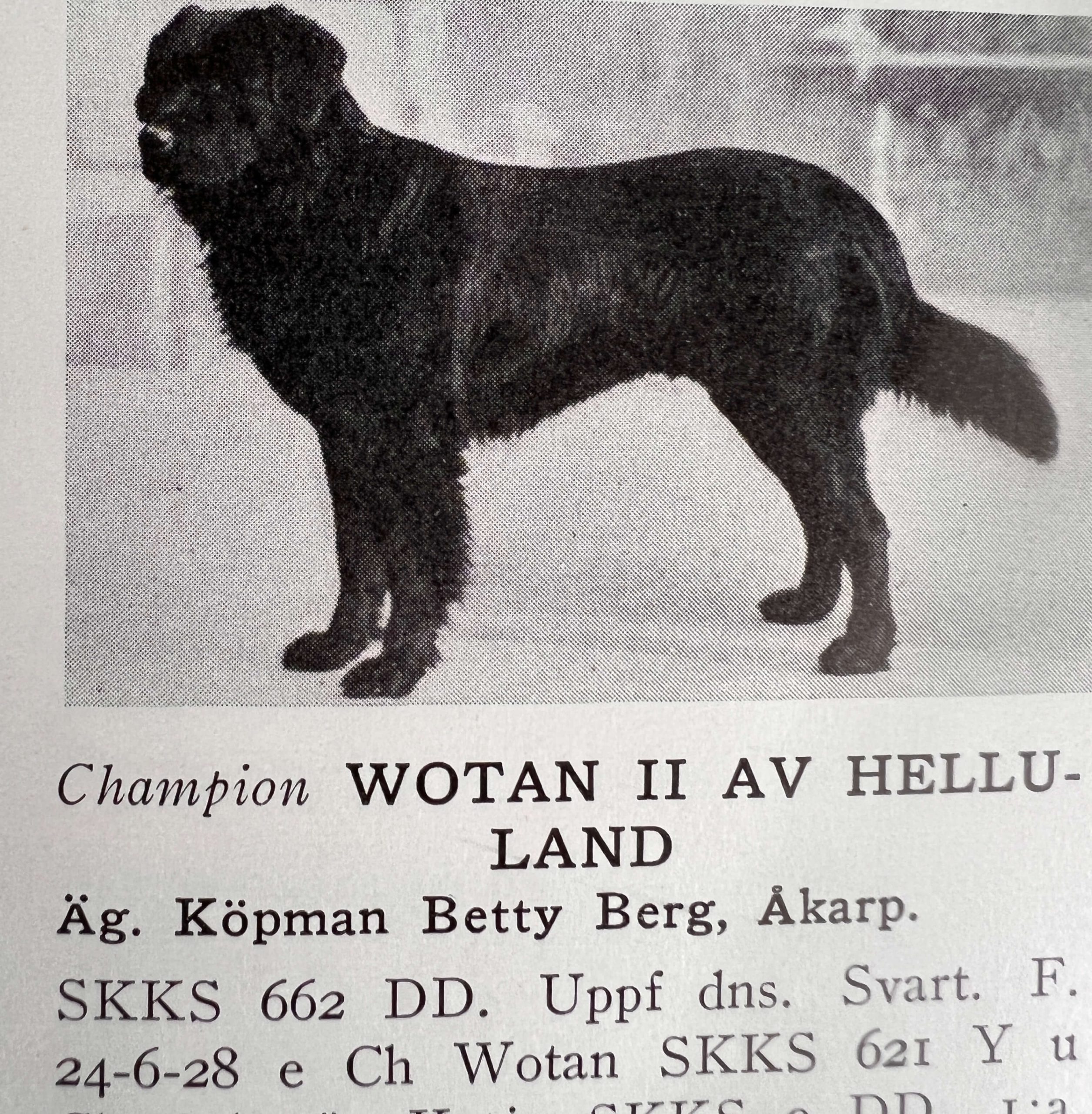
This is a New Foundland show champion born almost 100 years ago -that coat would have no issues dealing with the normal summer heat. Compare that to today’s New Foundlands that also have a heavier body…….
Golden retrievers are a typical example of that. They used to have a coat consisting of short, thick wool and longer, shiny guard hairs. When they got wet from retrieving birds in the water, they dried quite quickly. Nowadays, they have heavy, long coats consisting of lots and lots of long wool, and it gets even longer if you neuter them.
Neutering also causes changes in the coat growth cycle and changes the coat. Most breeds that we class as “double coated” get twice the amount of undercoat that nature intended, and the undercoat can sometimes be much longer than normal. The undercoat is not shedding in the same way it used to, leaving the dogs with non-functional coats.
( Spaying-induced coat changes: the role of gonadotropins, GnRH and GnRH treatment on the hair cycle of female dogs Iris Margaret Reichler,Monika Welle,Christine Eckrich,Ursula Sattler,Andrea Barth,Madeleine Hubler,Claudia S. Nett-Mettler,Wolfgang Jöchle,Susi Arnoldhttps://onlinelibrary.wiley.com/doi/abs/10.1111/j.1365-3164.2008.00652.x )
We have messed up the system that nature once created – but nature hasn’t changed the thermoregulation system – it still works in the same way and now faces bigger obstacles with more hair that insulates the body.

Heat is created by all the processes in the dog’s body—heartbeat, breathing, bowel movement, and so on. It’s like a little motor going inside the dog 24/7—and just like a motor, it needs to be able to dissipate excess heat to avoid overheating.
To maintain a constant body temperature, heat must be transported from the core of the body and released into the environment in several ways:
(Heat Production and Heat Loss in the Dog at S-36°C Environmental Temperature H. T. HAMMEL, C. H. WYNDHAM2 AND J. D. HARDY )
https://research.amanote.com/publication/4pY82nMBKQvf0Bhivs7m/heat-production-and-heat-loss-in-the-dog-at-836c-environmental-temperature
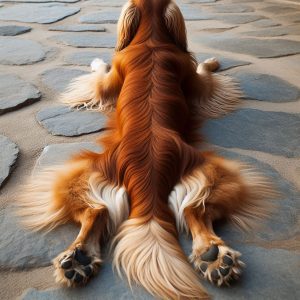
Conduction: occurs when the body is in direct contact with a cooler surface, thereby transferring heat from the dog to that surface.
You can notice, for example, that dogs prefer tiled floors when they are warm rather than fluffy carpets. Or they dig a hole in the ground and lie in it rather than on the grass.
Most dogs have a thinner coat on the stomach, so it is easier for the heat to leave the body when in contact with a cooler surface—that’s why they lie flat on the stomach on the ground or tiled flooring, for example.
Some heat is also transported from the skin through the hair shaft to the coat’s outer layer if the environmental temperature is lower than on the skin.

Convection: the removal of heat from the body as air passes over it, as seen with a fan or wind or when the dog moves and the hair moves. The movement of the hair allows the heat trapped inside the coat to escape. ( -if the dog is brushed so that the hair can move – a matted compact coat won’t move and therefore won’t release any of the heat )
The amount of heat released depends on the coat’s length and thickness and the airflow’s strength. The longer /thicker the coat, the less air is released.
If you have a short coat – or no coat like us humans – the wind will cool the skin as it passes over it unless the wind is warmer than the body. This is why it feels cooler to be by the sea on a sunny day compared to being stuck inside the city with no wind -even if the environmental temperature is the same.
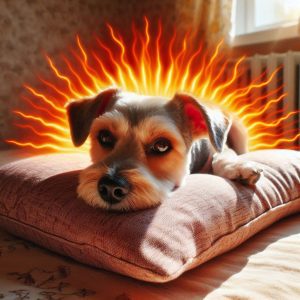
Radiation: when the body releases heat into the environment.
When the body’s heat production is stable, the blood flowing into the skin is regulated depending on changes in the surrounding temperature. The purpose of this regulation is to ensure that the difference in temperature between the skin’s surface and the environment remains constant, thus regulating heat loss and maintaining an almost constant body temperature.
When heat production increases, blood flow from the core to the skin increases, which, in turn, increases the heat lost from the skin to the same rate as the excess heat production. Blood flow to the skin can vary depending on the requirement for heat loss or conservation. The sympathetic nervous system regulates this blood flow. An increase in core body temperature causes the blood vessels to expand, increasing the blood flow from the core to the skin and, therefore, heat loss.
If the core temperature is getting too low, the blood vessels shrink, and blood flow decreases to minimize heat loss.
A layer of air is trapped between the skin’s surface and the coat’s outer surface. Air has a low heat capacity and is a poor conductor of heat; therefore, it serves as an insulator.
The degree of insulation can be altered by increasing or decreasing the thickness of the air layer. This is achieved by a small muscle attached to each guard hair, which allows the body to move the guard hair closer or further away from the body.
If you need more warm air trapped in the coat, the guard hairs rise, allowing more air to enter. If you want less air, the guard hairs lay flatter, minimising the space. It is like when we get cold with goosebumps and the hair on our arms or legs stands straight out.
This means that heat radiates from the skin into the air inside the coat, wrapping the dog in a warm bubble. This is good when it’s cold outside, but it will be an issue when it’s warmer.
Nature has considered the issue of the coat’s insulating effect and created so-called thermal windows. In these windows, the coat is shorter or thinner, making it easier for the heat to dissipate into the environment if needed. You find them on the stomach, ears, front of the front legs, and the lower part of the back legs.
The skin is thinner in these areas, and there are larger superficial blood vessels to facilitate the heat’s exit from the blood.
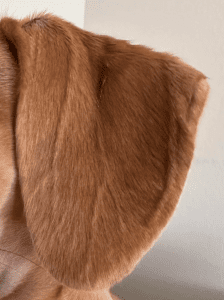
This is very visible on the ears of short-haired dogs, for example.
When the core temperature is increased, blood is mainly directed to these areas.
(The effect of rate of heating and environmental temperature on panting threshold temperatures of normal dogs heated by diathermy , Allan Hemingway
https://journals.physiology.org/doi/abs/10.1152/ajplegacy.1938.122.2.511)
If the dog is fat, the radiation will be less effective as the fat doesn’t transport heat well. So, the fat will act as insulation and keep the heat inside the body. (And keep the dog warm if it is cold.) This is why Arctic animals have a thick layer of fat to help them stay warm.
The first three mechanisms listed are only effective if the air around the animal is cooler than the temperature of the animal. At high environmental temperatures, the animal must solely rely on so-called evaporative cooling mechanisms: sweating and increased respiration.
Evaporation: the process when a fluid is changing into a vapour.
It happens in 3 ways in dogs – panting, sweating on the skin and sweating from the pads.
Sweating from the skin and pads does not greatly contribute to heat loss; panting is the main one.
Sweating can help cool the skin and, therefore, contribute to the dog’s general cooling. When fluid evaporates, it cools the surface as energy is removed when the fluid changes to a gas.
( read more about evaporative cooling at
https://www.scientificamerican.com/article/chilling-science-evaporative-cooling-with-liquids/ )
This is the same thing if you have been in the pool and get up—you can feel that your skin is cool as long as the water is on it. And if it’s a bit windy, then it feels even cooler.
But if the coat is long and thick, there won’t be any evaporation, as the air inside the coat will be warm, and there will be no temperature difference between the fluid and the air.
As the environmental temperature increases above 32 C, evaporation becomes the body’s most important way of releasing heat, and heat radiation from the skin becomes less effective.
It happens in the soft tissue of the upper respiratory system and mouth and is increased by panting. The hot blood reaches the tissue in the nasal cavity, and evaporation occurs when the hot blood heats the tissue and meets the cooler air. To keep the air in the upper respiratory system cool, the dog must pant when it reaches a certain temperature.
The main mechanism of heat loss during panting is water evaporation from the moist soft tissue in the nose. The heat of evaporation is removed from the tissues in the nose, cooling its blood supply. The cooled blood is collected in large veins and then passes through a small but dense network of blood vessels which functions as a heat exchanger, cooling arterial blood to the brain.
Under moderate heat stress, the dog pants with its mouth slightly open, and its tongue remains inside the mouth. Under significant heat stress, panting increases, the mouth is wide open, and the tongue hangs out to maximise heat loss.The shorter the nose is – the harder it is for the dog to maximise the heat loss this way.
The cooled blood then returns to the body’s core, which reduces the core temperature.
If the relative humidity is also high, evaporative cooling is less effective, and there is a high risk of heat stress.
If the environmental temperature lowers the core temperature, the body must create more heat.
One way is to shiver. This increases heat production as a chemical reaction called an exothermic reaction happens in the muscle cells when stored nutrition in the cells is converted to energy. Shivering is more effective than exercise at producing heat because the dog remains still. This means less heat is lost to the environment via convection as the dog is not moving around.
They also raise their guard hairs to trap more air within the coat so that heat radiated from the body can keep the skin warm.
Muscle movement also creates heat, so moving around heats the dog. This heat input will also continue for a time after the movement stops, which is why exercise can cause heatstroke several hours after the activity stops. Movement is not an economical way of creating heat as it uses energy to move the muscles.
Now when we know how the system works – what can we say about the effect of lots of hair on the dog?
“Contrary to the cold environments, increased insulation of fur is not beneficial to maintaining heat balance in warm environments. “
Seasonal Changes in Heat Balance of Dogs Acclimatized to Outdoor Climate
Yasuyuki SUGANO
https://www.jstage.jst.go.jp/article/jjphysiol1950/31/4/31_4_465/_article/-char/ja/
The hair is there as insulation – to prevent heat from LEAVING the body. Air is trapped between the hairs and insulates as it prevents heat from leaving the body and cold air from reaching the skin. So, the more hair – the less chance of heat leaving the body surface……unless it’s windy or the dog is moving around, and the coat is well-kept – as the heat can escape when the hair is moving.
However, only a certain amount of heat can escape, and the longer/thicker the coat is, the less effect we have from the hair movement. This is why it is important to keep a long-haired dog well-brushed and to remove excess undercoat if we are going to keep it longhaired.
Here is what some experts on thermoregulation say about the effect of long coats
“However, a thick insulating pelage is a disadvantage in situations where the energy supply is unlimited, and expenditure is constrained by the capacity to dissipate body heat. This is because the pelage insulation becomes the primary constraint on heat loss.”
Maximal heat dissipation capacity and hyperthermia risk: Neglected key factors in the ecology of endotherms
Article in Journal of Animal Ecology · April 2010 John Speakman ,Elzbieta Krol
https://www.researchgate.net/publication/44574615_Maximal_heat_dissipation
_capacity_and_hyperthermia_risk_Neglected_key_factors_in_the_ecology_of_
endotherms/link/5a6721cfaca2720266b43a31/download
“A thick haircoat decreases heat dissipation by adding layers of insulation and limiting effective cutaneous vasodilation”
Heatstroke:Thermoregulation,pathophysiology and predisposing factors
C.Hemmelgarn,K.Gannon
http://vetfolio-vetstreet.s3.amazonaws.com/50/39d930bce411e28e71005056ad4736/file/PV2013_
Hemmelgarn1_CE.pdf
“Clipping the coat short decreases its insulating abilities by 50% ”
( Predicted thermal responses of the military working dog (MWD) to chemical, biological, radiological, nuclear (CBRN)protective kennel enclosure by Larry G. Berglund, Ph.D.Miyo Yokota, Ph.D.William R. Santee, Ph.D.Thomas L. Endrusick, B.S.Adam W. Potter, B.A.MAJ Scott J. Goldman, V.M.D., Ph.D.Reed W. Hoyt, Ph.D.
https://www.researchgate.net/publication/279517419_Predicted_Thermal_Responses_of_
Military_Working_Dog_MWD_to_Chemical_Biological_Radiological_Nuclear_
CBRN_Protective_Kennel_Enclosure )
A large amount of studies on cattle, sheep, alpacas, and horses show that clipping the coat short reduces the heat stress in the body. I have listed a few here :
Hair coat characteristics in Friesian heifers in the Netherlands and Kenya by H.Veenman
https://www.proquest.com/openview/df176da79a3b42df7f55cd4aca470e82/1?pq-origsite=gscholar&cbl=2026366&diss=y
The effect of clipping the coat on various reactions of calves to heat. ByW.Bianca https://www.cambridge.org/core/journals/journal-of-agricultural-science/article/abs/effect-of-clipping-the-coat-on-various-reactions-of-calves-to-heat/305C548254DE41EF35E5FB380A41887C
Effects of seasonal changes and shearing on thermoregulation, blood constituents and semen characteristics of desert rams by Mohammed Suahir , M Abdelatif Abdalla https://europepmc.org/article/med/24517003
The effect of coat clipping on thermoregulation during intense exercise in trotters K. Morgan*, P. Funkquist† and G. Nyman
https://beva.onlinelibrary.wiley.com/doi/abs/10.1111/j.2042-3306.2002.tb05484.x
How does the heat move within the coat?
This is when things get complicated, and misunderstandings create the myth of the heat-insulating coat.
The hair does insulate against heat –but only against instant heating of the skin -it doesn’t prevent heat from getting into the coat -it only prolongs the time it takes for the heat to get in there. And once it’s there it’s very hard for the dog to dissipate it.
I will cite a great example from Dr David Marlin -a UK specialist on thermoregulation in mammals –
‘If we take 2 dead dogs, one is short-coated, and one is long-coated and put them in the freezer until they are deep-frozen. Then bring them out on a warm day and let them lay there to defrost- the longhaired dog will take longer to defrost thanks to the coat insulating properties
BUT
Live dogs produce heat 24/7, and that heat needs to be able to dissipate, or the dog will overheat. This is the issue with the long /thick coat -it prevents the heat from leaving the body. “
( https://www.facebook.com/photo.php?fbid=550815746649470&set=pb.100051631481906.-2207520000..&type=3
The normal temperature inside the coat of a golden retriever. The first reading you see is the room temperature, and the second is the temperature inside the coat. This is done indoors, so no sun radiation is heating the coat’s surface.
Heat radiates from the skin and heats the air inside the coat. That warm air slowly heats the air layers further out in the coat until it reaches the surface of the coat. This is because heat is always travelling from warm areas to cold areas. Once it meets the environmental air, the transfer will stop.

But if the temperature on the coat’s surface is higher than inside the coat, the same transfer will now happen, but it will be reversed.
The warm air on the surface of the coat will heat the air at the inner layer of the coat, transferring heat down into the coat instead.
This transfer stops once the temperature is even throughout the coat.

A prime example of that “reversed” transfer of heat is when you have a dog that lays on a heating pad during surgery.
(When dogs are under anaesthetic, their thermoregulating system is compromised. So, you’ll need to keep them warm during the procedure.)
The danger is that the heat from the heat pad will be transferred to the skin, causing thermal burns.
This is a frequently occurring issue, and it is discussed in depth in scientific literature.

Photo courtesy of Amanda Madtes
https://www.facebook.com/celtick9
Another factor that you must include is that if the sun is shining, the sun’s radiation will heat the coated surface. That heat will later be transported down into the coat and heat the air inside the coat through heat transfer.
The isolating air layer the undercoat creates at the skin’s surface will delay the direct heating of the skin, but it will eventually happen.
( ” The microclimate of the canine coat, the effects of heating on the coat and skin temperature ” https://onlinelibrary.wiley.com/doi/abs/10.1046/j.1365-3164.1997.d01-12.x )

( you can read more about the laws of heat transfer on Wikipedia – https://en.wikipedia.org/wiki/Heat_transfer
You can read more on how it works specifically in a coat in my post A deeper look into the role of the coat in the dog’s thermal regulation –
Recent studies have shown that different hair structures allow different amounts of heat to be directly transferred to the skin.
Tight curls allow for only 1/3 of the length of straight hair, giving Lagotto Romagnolo an advantage over a shih tzu, for example.
(https://www.researchgate.net/publication/340811439_Hair_fiber_morphology_and_
function_at_the_intersection_of_anthropology_physiology_and_engineering )
However, they also show that double coats are more effective in preventing the heat from escaping to the coat’s surface. This is logical as the breeds we call double-coated originate from colder climates.
( Quantifying body surface temperature differences in canine coat types using infrared thermography
Claire J Kwon, Cord M Brundage Journal of Thermal Biology 2019 May;82:18-22)
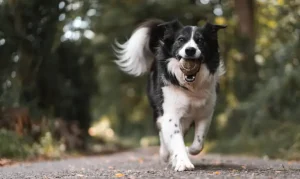
‘A typical example of how it works on dogs, and in this case, we even have it proved that so-called double-coated breeds don’t” catch ” cold air to keep them cold 😊 :
C J Chesney did a study in 1996,” The microclimate of the canine coat, the effects of heating on the coat and skin temperature ” ( https://onlinelibrary.wiley.com/doi/abs/10.1046/j.1365-3164.1997.d01-12.x ) and showed that the temperature inside the coat on a group of 6 border collie type dogs, that was outside playing in a field on a sunny day, had a median temperature of 38 C ( range between 37-40 C ) when the environmental temperature was 21 C.
That is 17 C warmer inside the coat than in the environment—even though the dogs were running around outside—so there must have been some movement in the coats that allowed some heat to dissipate.
Another part of the study included 7 New Foundland dogs kept indoors at 23-25 C. The temperature inside the coat was 30 C – again, it’s warmer inside the coat than in the environment. They then let the dogs sit under an infrared lamp for 25 minutes -approximately—1 meter from it. The temperature inside the coat rose to 41C as the coat’s surface got heated.
The surface heat got transferred down into the coat, and the dogs were negatively affected by the heat increase, so they ended the experiment at this point due to the dog’s apparent heat stress.
They could also see that the humidity inside the coat increased -showing that dogs do sweat through the skin.
Other studies have also shown that this happens, but the general conclusion is that it does not significantly contribute to heat loss through evaporation.
– So, you see- a double-coated dog has no special coat that catches cold air or is isolated against sun/environmental heat. They will also be affected just like any other dog.
Here is another study that talks about the fact that it is warmer inside the coat than in the environment:
“Increasing the air temperature in the model caused the temperature through the depth of the hair coat to also increase. This causes the temperature gradients through the boundary layer to decrease and an associated lowering of the sensible heat loss from the skin surface.
For example, at an air temperature of -20°C, the temperature at the hair-air interface was – 16″C, that is, 4°C higher than the air temperature. At 20°C, the temperature at the hair-air interface was higher than the air temperature by 2:C and at 35 C. by I°C (Fig. 2).
The sensitivity of the temperature profile to changing ambient temperature and wind speed shows the effectiveness of the hair coat, the boundary layer, as a heat-conserving medium. “
(A MODEL OF SENSIBLE HEAT TRANSFER ACROSS THE BOUNDARY LAYER OF ANIMAL HAIR COAT K. G. GEBREMEDHIN Agricultural Engineering Department, Cornell University, Ithaca, NY 14853, U.S.A
https://www.sciencedirect.com/science/article/abs/pii/0306456587900155.)
K. G. GEBREMEDHIN also says in his article ; A model of sensible heat transfer across the boundary layer of animal hair coat ;from 1986 that: “In the absence of solar radiation, the temperature profile through the depth of the hair coat decreased non-linearly from the skin temperature to the hair-air interface. The temperature at the hair-air interface is higher than the air temperature. “
So, it is warmer inside and on the coat than in the surrounding environment.
The conclusion is, If we want the coat to keep less heat – make the coat shorter
The benefit of hair
The coat, on the other hand, is important because it protects the skin from damage and the dog from the elements.
If your dog is an average pet, only a short layer of hair will protect the skin—look at all the short-haired breeds. Your house will protect your indoor dog from the elements. Use common sense and leave a short protective layer—don’t scalp the dog down to the skin.

But it’s an important factor if you have a working dog—a dog that is exposed to strong sun radiation, harsh weather, brambles, bushes, and maybe even attacks from other animals. They do need a thicker layer to protect them than a pet dog.
And this is where it gets complicated -again…….
One key heating factor is, as I mentioned before, the radiation from the sun –
We know that dark colours absorb more heat from solar radiation than light colours. You know yourself the burning feeling on your legs if you wear black jeans on a sunny day – this is why summer clothes have light colours 😉
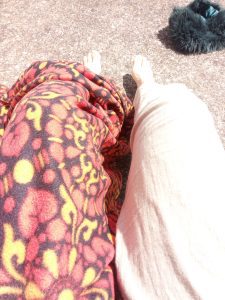
If you put a blanket over your legs to prevent the sun’s radiation from reaching the black fabric, it feels cooler. But after a while, you will be warm under the blanket as it now prevents the heat from leaving your body.
It works the same way with a dog’s coat. A short dark coat allows solar radiation to heat the surface much faster than a longer light-coloured coat.
The surface will be kept cooler on the dog with the longer light-coloured coat – but the radiation will eventually heat the surface on this dog.
But once the sun radiation disappears, the short black coat will allow the dog to cool down quickly, as the heat from the body can disappear through the short coat quicker than on a dog with long hair.
The same goes for reflective hair – shiny hair will help reflect the solar radiation away from the surface (like the reflective sheets you can put on a window ), preventing surface heating. But – Radiation can penetrate deeper into a white coat than a black one (because it keeps being reflected), so some of it is reflected onto the skin.
With a dark coat, since the part that heats up stays closer to the surface, wind can remove it more quickly. With enough wind, a black-haired animal will gain less heat from radiation than a white-haired one.
But if we neuter the dog, the structure of the hair changes, and it usually gets duller/less shiny ( and we get more wool as well ). It’s the change in the hormones that affect the coat and alters the coat growth cycle so that the undercoat grows longer
( Spaying-induced coat changes: the role of gonadotropins, GnRH and GnRH treatment on the hair cycle of female dogs Iris Margaret Reichler*, Monika Welle†, Christine Eckrich*, Ursula Sattler†, Andrea Barth*, Madeleine Hubler*, Claudia S. NettMettler‡, Wolfgang Jöchle§ and Susi Arnold. )
And we then lose the shiny, thin coat and get a dull, thick coat instead that reflects less sun and insulates more
Lots of breeds have been created to have fewer guard hairs and more wool -there are then very few shiny guard hairs left to reflect the sun radiation (poodles and bichons are typical breeds)
Suppose you clip a golden retriever, leave 1 cm of hair, and do the same on a poodle. In that case, they will have precisely the same adverse effects of clipping regarding the ability to reflect solar radiation and environmental protection. It’s no difference between the breeds.
The other external heating factor is the environmental temperature.
“Maximal heat dissipation capacity will also be dependent on the difference between the body temperature and the environmental temperature. Consequently, animals in colder environments will be able to lose more heat.”
Maximal heat dissipation capacity and hyperthermia risk: Neglected key factors in the ecology of endotherms Article in Journal of Animal Ecology · April 2010
https://www.researchgate.net/
publication/44574615_Maximal_heat_
dissipation_capacity_and
_hyperthermia_risk_Neglected_key_factors_in_the_ecology_of_
endotherms/link
/5a6721cfaca2720266b43a31/download
A large number of studies have been done on animals with the same thermal regulation as dogs, and they all conclude that –
“Animals that live in environments where the temperature changes throughout the seasons get a long thick coat during the winter and a much thinner and shorter coat during the warm season. “
So, it is obvious that nature aims to keep the animal cooler with a shorter, thinner coat during the warm season.
Dogs do adapt to the environment—if they spend a long time in a hot environment, their body gets used to it, and the thermal regulating process starts at a higher body temperature. But it takes time for the body to do this adaptation. It takes between 20 days and around 2 months for the body to adapt to the new climate.
This makes it hard for dogs in countries like Sweden or the UK, where the hot weather is present only for a short period and usually arrives suddenly without a chance for the dog to get used to it.
We can see the same thing happening with dogs that move from warm to cold climates. They will eventually get a thicker coat, but they will suffer from the cold in the beginning.
If the surrounding temperature is high but there is no direct radiation—like on a cloudy day or when you are in a car or indoors—then the coat length/thickness is a contributing factor to the ability to keep cool. The longer and thicker the coat is, the harder it is for the dog to stay cool, as the heat radiating from the body won’t leave the coat and heat the dog.
Studies show that animals with shorter, thinner coats deal better with heat than those with long, thick coats if there is very little wind, which helps the heat escape from the air trapped inside the coat.
(Effective thermal conductivity of the hair coat of Holstein cows in a tropical environment Alex Sandro Campos Maia2, Roberto Gomes da Silva3, João Batista Freire de Souza Junior2, Rosiane Batista da Silva2, Hérica Girlane Tertulino Domingos
https://www.scielo.br/j/rbz/a/rmg5nCy49SQxCNVDvgBQS4G/abstract/?lang=en)
Scientific literature concludes time after time that long, thick coats add to the risk of overheating; clipping the coat shorter improves the heat loss from the body and keeps them cooler
Here is a list of several scientific papers that conclude that it’s not beneficial for dogs to have a lot of hair if you want to keep them cool :
“Predisposing factors for heatstroke
-thick haircoat “
ShortTechnical Report on Thermoregulation in Dogs and the Pathophysiology of Hyperthermia Jerilee A. Zezula, D.V.M
http://neacha.org/resources/Short%20Technical%20Report.pdf
“Predisposing Factors for Heatstroke
– thick haircoat “
Heatstroke – thermoregulation, pathophysiology and predisposing factors Carey Hemmelgarn DVM ChristI Gannon DVM DacVecc
https://www.vetfolio.com/learn/article/heatstroke-thermoregulation-pathophysiology-and-predisposing-factors
“Factors that inhibit heat dissipation:
Thick, dense coat – increased insulating effect“
Hyperthermia and Heatstroke in the Canine
Lori E. Gordon, DVM
http://usarveterinarygroup.org/usarvet/wp-content/uploads/2016/08/Hyperthermia-and-Heatstroke-in-the-Canine.pdf
“Well-insulated breeds with thick fur and fat may struggle to maintain a normal body temperature,
especially during hot summer days and in a warm ambient environment.“
Hyperthermia during anaesthesia
Author : Clara Rigotti, Marieke De Vries 2010
https://www.vettimes.co.uk/app/uploads/wp-post-to-pdf-enhanced-cache/1/hyperthermia-during-anaesthesia.pdf
“Well-insulated breeds, such as Chow Chows and St. Bernards, may struggle to maintain normal core body temperature, making them more prone to hyperthermia, especially in a warm, stressful environment”
Hypothermia in a chow chow under general anaesthetic
H.Jones, K.Robson ,2022
https://bvajournals.onlinelibrary.wiley.com/doi/full/10.1002/vrc2.423
“Predisposing factors that decrease heat dissipation:
Hair coat – Thicker coats decrease radiation and convection“
Heatstroke in small animal medicine: a clinical practice review
Scott I. Johnson, DVM, Maureen McMichael, DVM, DACVECC and George White, DVM
https://onlinelibrary.wiley.com/doi/abs/10.1111/j.1476-4431.2006.00191.x
“Another group of dogs needing special consideration for temperature ranges are those with extremes in coat type, both those with particularly thick coats, such as Siberian Huskies, and those with thin to absent coats, such as Chinese Crested dogs. Thicker coats decrease heat loss from the skin (Johnson et al., 2006). Without proper attention, such dogs may face thermal distress at higher temperatures than might be acceptable for other dogs”
Temperature requirements for dogs
Mary Jordan, Amy E. Bauer, Judith L. Stella, Candace Croney
Department of Comparative Pathobiology, College of Veterinary Medicine
https://www.extension.purdue.edu/extmedia/va/va-16-w.pdf
However, there is a situation when it doesn’t matter how long or short the coat is. That is when the environmental temperature exceeds 38C/101F. At this point, it won’t matter if the coat is long or short, as the environmental temperature will be higher than the body temperature, no chilling of the skin will be possible, and no heat transfer from the body will occur.
As the inner and outer temperatures will be the same, no heat transfer will happen in any direction.
The dog is now solely relying on panting for heat reduction, which causes stress on the body. Excessive panting is hard work, and if you remember what we said before about muscle work creating more inner heat, you can imagine the outcome. It turns into a vicious circle, and the dog will be in trouble and need help from us to keep cool.
For example, we can wet it down to the skin, as the water’s evaporation will chill the skin and help with heat loss.
Are there any negative effects of clipping the coat short?
Is there a loss of protection from the elements?
The guard hairs do have a purpose—on EVERY BREED, not just the double-coated ones. That is why we, for example, prefer to hand strip wire haired breeds, as the wire guard hairs protect better than the soft clipped coat.
They prevent the undercoat from getting wet or dirty and protect the skin if the dog is attacked by predators.
Any breed that gets clipped/has its guard hairs removed will be exposed to the elements in one way or another. So-called double-coated breeds won’t suffer more than a Chinese crested from exposure to the elements – the “suffering” is equal.
But we must also acknowledge in this discussion that there is a huge difference between a pet dog and a working dog that lives outdoors 24/7. A pet dog will have protection from the elements as it lives indoors, and we can put a jacket on it when it rains.
So the loss of the guard hairs won’t matter that much to them compared to a wild dog or a dog that lives outdoors 24/7 all year round.
And we have a lot of breeds that naturally don’t have guard hairs that cover the undercoat and they still survive – look at poodles and bichons for example.
Again, we must remember that shaving the dog naked is not beneficial if you want to clip it short for the summer—regardless of breed. Leave a bit of hair as protection for the skin, and you don’t have to worry about the dog being without protection from the elements. And it is no different if it’s a poodle or a golden retriever.
Risk of sunburn?
A common argument against clipping is, ” The poor dog will get skin cancer if you clip it. “
Any dog that gets scalped with a 30-blade in reverse will suffer sunburn if we don’t allow the skin to gradually get used to the sun and get a natural pigmentation to protect it.
But very few so-called double-coated dogs get clipped that short. On the other hand, a lot of show poodles get clipped with that blade every year all over the world, and no one says anything about it… And there are no indications that they have an increased ratio of skin cancer.
Solar dermatitis is not uncommon in dogs. It affects the white-haired and non-pigmented skin of short-coated breeds such as pit bull terriers, Staffordshire bull terriers, bull terriers, boxers, Dalmatians, and similar dogs, but any dog with white or lightly pigmented hair and skin is at risk.
(Diagnosis and treatment of solar dermatitis in dogs 2007 Kimberly S. Coyner, DVM, DACVD https://www.dvm360.com/view/diagnosis-and-treatment-solar-dermatitis-dogs )
No written papers I have read mentioned clipped double-coated breeds being of extra high risk—they all mentioned naturally short-haired breeds—for skin cancer and solar dermatitis.
But if you shave a golden retriever with a 30 blade in the middle of the summer -their skin will, of course, be as sensitive as the non-pigmented skin on a bull terrier.
It’s important to use common sense if you clip a dog short for the summer! Leave at least 1 cm of hair to protect the skin. Clipping the dog with a 7F or a 4F will not make a huge difference from a heat dissipation point of view, so leave some protection.
A dog can get severe burns from the sun if they are exposed to intense UV sunlight and high temperatures while in a high attitude for a prolonged time – it is more common in short-haired dogs with a dark coat ( as the dark colour attracts the heat from the sun ) – but you can see it dogs with lighter coats as well.
( Dorsal thermal necrosis in dogs -a retrospective analysis of 16 cases in southwestern USA 2009-2016 Stephanne L Swartz, Anthea E.Schick, Thomas P Lewis, Diana Loeffler
https://onlinelibrary.wiley.com/doi/abs/10.1111/vde.12519 )
But this means that all breeds with short dark hair are at risk – not just a clipped collie. So every owner needs to consider if they live in a high-risk area – regardless of breed. And again – don’t skin the dog….. leave some hair to protect the skin.
Have a look at the pictures below –
Here are 5 different breeds clipped with the same blade

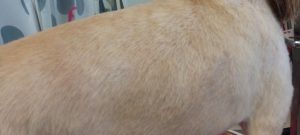

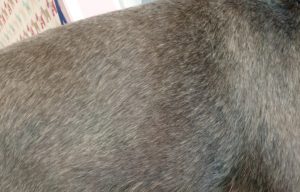
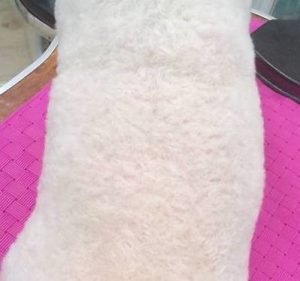
According to the No side –one of them will suffer – the rest will be ok –“ as they have a different coat and thermoregulation. “……..
Can you spot the one that will suffer?
Probably not, as all of them will be wet when it rains, all of them will have an increased risk of getting cuts when running through brambles, and a couple of them will have an increased risk of changes in the coat texture due to the clipping.
But they ALL regulate their body temperature in the same way – there is not a different thermoregulation system for double-coated breeds.
But what about the destroyed coats if you clip a double-coated breed?
This is where the problem arises when we talk about clipping dogs short for the summer.
Some breeds can get changes in their coat if we clip them, and that can be an issue later on as it can take a long time before they grow back to the usual look. It can be as long as several years before it gets back to normal in the breeds with a “Nordic type” of coat ( huskies, Samoyeds and similar )
We must, therefore, weigh the pros and cons before deciding if we should clip them.
By clipping, I don’t mean scalping the dog with a 30-blade; clipping just means making it shorter.
Why can the coat change?
( more info can be found in the book Muller and Kirks Small Animal Dermatology )
“The coat is there to protect the skin from damage from the environment and to help the dog keep its core temperature regardless of the environmental temperature. “
The term COAT describes the mass of hair that covers the dog – and the term HAIR is the individual hairs that form the coat.
Two types of hairs primarily comprise the coat – guard hairs and wool/undercoat. (some breeds have 2 different types of undercoats) Dogs also have tactile hairs – what we usually call whiskers
The guard hairs can be different textures depending on the dog’s breed. The dog can have different types of guard hairs on different body parts—collies, for example, have short guard hairs on their face and part of the legs and then long guard hairs on the body. The wool is shorter and softer in texture and mostly looks the same all over the body.
Every breed is, in fact, double-coated – all dogs have a shorter woolly undercoat to keep them warm and stronger, longer guard hairs that are aimed to protect the undercoat from being wet and dirty. However, through selective breeding, we have changed the coat in some breeds, and it can nowadays be hard to see the difference between wool and guard hair – as in poodles, for example. We have also aimed for less undercoat in some breeds, and they can, for the naked eye, appear as single-coated – Yorkies are one of them.

Breeds traditionally classed as “double-coated” in grooming terminology are those with longer wool and longer guard hairs, but there is still a clear definition between the wool and guard hair and the hair that lays down.
They are seldom styled—most are left natural and get a tidy up. A typical example is the golden retriever, Tibetan spaniels, and Newfoundland. This group includes the “Nordic type” breeds—dogs that have a spitz-type coat with thick, short wool and stronger guard hairs, and both the wool and guard hairs stand out from the body rather than lying down.
The name Nordic type comes from the fact that most of them originate from cold climates—Siberian Husky, Norwegian Elkhound, and Samoyed are some examples.
Spaniels, terriers, and schnauzers also have a typical “ double coat” that works just like nature intended—strong, shiny guard hairs protect the short, thick wool that keeps them warm—but they are not, for some strange reason, included in the term “ double-coated” in the discussions.
As mentioned before, all dogs have a double coat, including wool and guard hair. They have separate growth cycles. Several factors, such as hormones, temperature, daylight, nutrition, stress, and genetics, run the cycles.
There are 5 stages in the growth cycle.
Anagen or Growth Phase
The anagen phase is the first phase of new hair growth. Dogs that do not tend to shed heavily have a more extended anagen phase, while dogs that continuously shed have shorter anagen phases.
The amount of time the hair follicle stays in the anagen phase is genetically predetermined. Poodles, for example, spend almost 98% in the anagen state – their coat grows more or less constantly. Other breeds with short hair spend only a short time in this phase.
Catagen or Regressing Phase
The catagen phase is the transition phase. The catagen phase begins when the cell creation signals to stop. Hair stops growing during this phase as the outer root sheath attaches to the hair.
Telogen or Rest Phase
Telogen is a rest period between the catagen and anagen phases. This period varies depending on the dog’s coat type—in most breeds, it is the longest period in the cycle. Breeds with a “Nordic” type of coat—such as Huskies and Elkhounds—can spend several years in this phase.
This is nature’s way of using nutrition/energy in a good way – in a cold climate, you need the energy to keep you warm – not to grow a coat.
Exogen or Shedding Phase
The final phase, exogen, is the shedding phase. This phase occurs when the hair falls out, and the follicle moves back into the anagen phase. The length of this phase depends on the season.
A new phase has lately been introduced when we talk about coat growth phases – ‘‘kenogen’’: It applies to hair follicles that have passed the telogen stage, lost their hair fibre (exogen), and remain empty for a specific time before a new anagen phase is starting.
( The Hair Follicle: A Comparative Review of Canine Hair Follicle Anatomy and Physiology. Monika M. Welle and Dominique J. Wiener ,2016
https://pubmed.ncbi.nlm.nih.gov/27000375/)
And even more recently, a 6th phase has been suggested -zenogen. That is when a hair follicle is in the kenogen stage but ends up dormant -it never moves on to the anagen stage.
This can happen with certain hairless breeds and if the dog has a medical issue.
The hair follicles are in different stages throughout the dog. Some are resting; some are preparing to shed, some shed and some are creating new hair.
There is a practical reason for that – making new hairs demands a lot of nutrition, so if all hairs fell out at the same time, there would be a considerable amount of nutrition needed to create a full coat again – and it will be tough to fill that demand. However, if some hairs rest while others are made, the nutritional demand will be much lower.
( approx 30% of the nutritional intake goes to the skin and hair – but as this is the less important part of the body organs, it gets the leftovers after the heart, lungs, brain, and other organs have had their share )
We would also lose the purpose of the guard hairs if they all fell out at the same time—that would leave the dog without a “weather shield “ and expose the wool to the elements. This does happen when we clip them short ( regardless of breed ! ) -so clipping them short has its downfall—but it also happens when we strip down wire haired dogs such as Border Terriers and Jack Russels or clip a Shihtzu……
Remember that there is one cycle for the guard hairs and one for the undercoat/wool.
As I mentioned above, some breeds’ guard hairs can be in the resting phase for 4-5 years, while the undercoat usually has a 6-month cycle on most breeds. They shed and grow new undercoat twice a year, as the undercoat is there to keep them warm in the winter and gone in the summer to keep them cool.
During spring, they shed the thick winter wool and set thinner summertime wool, and then in the autumn, it is time to shed the summer wool and set thicker winter wool again.
The shedding of the wool is much more synchronised and usually happens simultaneously – at least, it feels like that when it happens ….
When we clip a so-called double-coated breed, there is a risk that the guard hairs won’t grow back for a long time, and the dog will look really stupid during that time. It all depends on where in the hair’s growth cycle when we clip the dog. It can grow back just fine, but in the worst-case scenario, it can be at the start of the resting phase, and it will be 2-3 years before all hairs are out at normal length.
Or the dog is elderly, and the body decides that nutrition is needed for more important things than hair….
During this time, the undercoat will now be the main protection for the skin. Due to the damage, it can turn into a more wire structure and become hard to keep mat-free.
Many elderly dogs also suffer from medical problems, which can affect their growth as the body needs nutrition to battle sickness—not to create hair.


Patchy regrowth on a spaniel is common in spaniel types of coats ( springer spaniel, cavalier, cocker spaniel ) when the dog gets older or has a medical condition. A thyroid problem is a common cause of this type of patchy regrowth. Lack of thyroid hormone delays the start of the growth phase.
It can sometimes be an underlying medical problem that suddenly becomes visible when you clip the hair. Some medical conditions cause the hair follicles to go into a permanent resting state.
You won’t see it until you clip the dog as the hair isn’t growing – but it’s not the actual clipping that caused it – it just made it visible.
When we clip them short, the body can also decide to put the hair follicles in a permanent resting phase. This is most common in the ” Nordic type” of breeds – but it sometimes occurs in other breeds as well.
The cause of this is still not known. One theory is that the cooling of the skin when the hair is gone gives a signal to the body to reduce the blood flow to the skin to keep the core heat, which affects the hair follicles’ growth cycle, moving them all to the telogen stage. Another theory is that hormones disrupt the growth cycle.
( A Colour Handbook of Skin Diseases of the Dog and Cat UK Version, Second Edition, Patrick J. McKeever, Tim Nuttall, Richard G. Harvey)
So YES- you might “destroy” the coat by clipping it short.
Or, to be correct – in most cases, you destroy the look of the dog. The coat isn’t destroyed as it’s just following its natural cycle – but the dog will look crap during that time.
If it’s a “Nordic” type of coat, it can take several years before it’s back to normal, and coat maintenance during that time can be challenging.
There is also a risk that underlying medical problems suddenly become visible or that the hair follicle goes into a permanent resting state, and the hair never grows back again. This is why it’s so important to inform the owner of how the coat growth cycle works and make them sign a paper stating that they are aware of what can happen if you, as a groomer, clip this type of coat.
We also must ensure thorough de-shedding before we clip them. This will remove as many of the hairs that are ready to be shed as possible, ensuring that the hair follicles are now moving on to the anagen stage and increasing the possibility of proper regrowth.
( And remember that this can happen to other breeds besides the ones we call “double-coated” – but the problem is more common in them. )
“I have heard that the undercoat gets thicker when you clip them – which will increase the risk of heatstroke rather than preventing it !! “
This is a claim that pops up during discussions, but I have never seen any evidence for it. I haven’t seen it on dogs I have groomed, and the groomers I have discussed this with haven’t seen it either.
I can’t find any mention of it in the scientific literature. All discussions in the scientific literature mention a thin coat or lack of hair.
However, I am open to corrections if any of my readers have any scientific papers/books that mention it :)-please comment or email me if you have anything and I add it to the text.
It is probably because we never see how much undercoat they have when the guard hairs cover it, which makes people think it is extra thick once they see it growing out without the guard hairs.
The undercoat that grows out before the guard hairs can be challenging to deal with -as it tends to mat up if the dog is neutered. So, it is important to wash and condition it on a regular basis to keep it in top condition. And do regular de-shedding treatments -just like we do when they have a “full coat”, as that helps to maintain healthy skin and coat.
So what shall I do ??
First and foremost, we must remember that the heat, sun radiation, wind, and humidity are different in different parts of the world. What can be completely okay in northern Sweden might not work in Arizona. Use common sense!
And acknowledge that different individuals have different tolerances to heat. My dogs are a prime example of that.
My poodle gets affected by the heat once his coat is longer than 3 cm-he is even hot in normal indoor temperatures. Once I clip him shorter, I have a new dog 🙂 He is like a pup again.
My fox terrier, on the other hand, can lay in the sun and roast for ages If I allowed her, she would sleep on top of my stove when I have a fire going.
Yes, if it’s a double–coated breed, the dog might end up looking stupid for years in the worst-case scenario, but it won’t die from heat stroke because you clip it. However, it might suffer from severe heat stress if you don’t clip it.
Look at the dog – if it is affected by heat, it needs a shorter coat.
” But I have heard that the dog can suffer from heatstroke if you clip it as you remove the insulation from the heat ?”
If there was an increased risk of heat stroke due to clipping, there would be many suffering dogs at the vet clinics and warnings in veterinary literature—dogs are clipped daily all over the world, and we still don’t see any warnings in the scientific literature.
I did a search on Google Scholar and didn’t get a single match when searching for “heatstroke-clipped dogs. “ On the other hand, I did get a lot of articles that said that one way of preventing heatstroke is to clip the coat short, as a thick coat increases the risk of heatstroke ………
( see previously posted links : Heatstroke: thermoregulation, pathophysiology, and predisposing factors, Carey Hemmelgarn 1, Kristi Gannon Pathophysiology and pathological findings of heatstroke in dogs Mariarita Romanucci, Leonardo Della Salda )
And yes, it won’t make a difference for some dogs if you clip them short or just wash them and remove all the dead undercoat—if it’s a light-coated dog like a long-haired chihuahua, for example. The dog will look so much nicer in its natural style.
But a fat, neutered, long-haired chihuahua with a thick woolly coat like a Leonberger will feel much cooler in a short trim. Use common sense, and don’t scalp it—leave 1 cm so that there is a layer of protection for the skin.

Or, shorten the coat on the body a little bit and do a proper de-shed treatment. Clip it short on the stomach to open a window for the heat to dissipate. The coat on the stomach has fewer guard hairs and a faster growth rate than the ones on the back, so we don’t see the coat damage there.
If it’s a working dog living outside 24/7 – like a dog that lives with a herd of livestock – they would need a long coat to be protected from the elements/predators and solar radiation. Most of those breeds are from areas where it is warm but windy – so you will have natural convection that moves the coat and releases the heat trapped inside. That dog would do better with a de-shedd and clipping a ” window “on the stomach.
These dogs don’t make explosive movements—they rest together with the herd and can choose to lay in the shadow—so they don’t create a lot of extra inner heat.
On the other hand, working dogs that do a lot of explosive work in hot environments—like army dogs, agility dogs, and Schutzhunds—benefit from being clipped shorter.
They do intense, prolonged work, which creates a lot of extra inner heat that they need to be able to dissipate.
For other dogs, the difference can be huge if you clip it shorter. This is especially true if the dog is overweight and old, as the fat acts as extra insulation and prevents the heat from radiating from the body, and old age makes the dog’s thermal system less effective.
Dogs with a thick coat that doesn’t get thinner due to brushing – Like a thick-coated poodle or a neutered Newfoundland, for example – will definitely get relief from the heat if they are clipped shorter.
The thick coats won’t release any heat as it’s not moving in the wind like a thin collie coat, and the guard hairs are either very few or dull due to neutering and, therefore, don’t reflect the sun’s radiation – so they won’t be missed if the dog is clipped short.
So I am sorry to say – the conclusion after all this reading is- there is no ” one size fits all ” answer.
Yes, a shorter coat will make the dog feel cooler, but we must also consider the risk of coat damage in some breeds.
You must look at each individual dog and make a decision based on this dog’s circumstances:
If it’s a breed where the coat has continuous regrowth—like a poodle—then it’s a no-brainer—clip the dog if you/the owner feel it’s struggling with the heat. A shorter coat will allow it to dissipate heat better.
But don’t scalp it-leave a bit of hair to protect the skin.
If it’s a “double-coated ” breed – then it gets a bit more complicated.
Is the owner prepared to have a dog that might look crap when the coat grows out due to uneven regrowth? – if so – clip it if that is what the owner wants. Just make sure they sign a paper that you have informed them.
Do you live in Ireland, where we have one week of “heat” per year?
Maybe it’s not worth the risk of uneven regrowth on a double-coated breed for that single week. It can maybe be managed by a good de-shedding treatment, clipping the stomach short, keeping the dog in the shade, and wetting it down if it appears hot.
But if the dog is old, neutered, has health issues or is overweight- the benefits will outweigh the risk of crappy regrowth.
Is it a collie or a husky?
Collies/retriever coats usually tolerate being clipped once a year for the summer without damage, so I wouldn’t worry that much.
Conversely, Nordic-type coats can look horrible for several years if you clip them—is it worth that risk? Will the benefit outweigh the risk? Look at the individual dog and decide based on that dog’s circumstances.
– if the dog struggles with the heat -I personally would rather have a dog with a crappy coat than a dead dog/or one with permanent damage to its body due to heat stress …….

Is it a dog constantly wet as it swims every day and, therefore, at a higher risk of hot spots? A shorter coat will prevent suffering and unnecessary medication.
If the dog is elderly, overweight, or has health issues, removing hair will make life easier for it.
If the dog lives in a climate with hot weather for 10 months per year, then it will really benefit from it. If the dog, on the other hand, lives in an environment with 2 weeks of warm weather, is not neutered, and doesn’t carry any extra weight, then other actions might be taken to keep the dog comfortable, and we can avoid the risk of uneven regrowth.
And remember – a double-coated breed won’t suffer more than a poodle from being clipped, and they get equally affected by the heat as any other breed.
They can´t ” catch cold air” with the undercoat. If it’s 30C outside -there is no cold air to “catch”.
Educate yourself and then make a decision based on facts – not based on random memes/posts on Facebook.
If you want to read more about the role of the coat in the thermoregulation process – go to my post about that subject:
A deeper look into the coat’s role in the dog’s thermal regulation.
Pingback: To shave or not to shave - a look into the literature about dogs thermal regulation,coat growth and more...... - MY HAIRY UNIVERSE
Pingback: Päls och temperatur reglering-den korta versionen 🙂 - My hairy universe
It would be great if you could provide a cheat sheet of what to do. Eg for double coat, in Australian hot climate, normal weight, pet, your options are…. . I have a science degree but getting to old to fully digest your excellent work into something I can use for my dog. Maybe a simply what to do. If people want to know why, point them to the complete article.
Hi Fred!
Sorry for the late reply 🫣
I am working on it ☺️ But I struggle to make it short 🤣
Thank you, Thank you for the very well referenced article on the many types of coats, and whether to clip short or not…
I have a Samoyed, live in MD a much warmer climate than the breed comes from, Siberia.
I also am a dog groomer with over 23 years experience.
So thought, ( and I do keep that abundant undercoat brushed out). Why not do some partial trim with a Andis #7 blade for the summer. Similar to a schnauzer body style….less
upkeep…..
Just might do it this year, he’s an in and out dog, in on those extremely hot days.
Will take pics, if I do and tell the results of the dogs freedom of all that bulky hair and the breeze able to reach his skin.
And if it’s a mistake,will tell you that also.
From Wilbur the Fox’s owner
Thanks for your nice comment.
Please report back on how your guy responded to the styling- its great to see real life results to different ways of tackling the heat issue☺️
Wow. Your article is very thorough and I love a well researched article and am often cited for being too verbose and people often tell me that no one reads (to which I dissent). But even I struggled to digest it all and finding a bottom line FOR ME and MY AUSSIE, but at least I know this is there when I can take a couple of hours to weigh all of that. I didn’t know this was such a controversial subject—or rather, I knew there were apparently two sides, and thought it was like that bc people are generally divided like that on many things—but now I see to shorten dog hair or not—is VERY muddy. I previously concluded that common sense tells me that a so called double coat isn’t fair to him IF IT is designed to TRAP HEAT at all, as an Aussie in the subtropics of Satsuma, Alabama; and I opt for comfort over human vanity about looks, though I have worried I was ALTERING his coat if I ever wanted to stop clipping (though he has been nearly shaved). After my first perusal of your article—by no means a close read—I am going to not shave except for the stomach and chest and feel okay about clipping. And try to brush and bathe more.
Hi Lana!
Thanks for your response to my work ☺️
Its a lot to digest and as its not a black and white topic- its hard to make it short 🫣😅
But the main thing is to look at your own dog. They are all individuals. Some tolerate heat well- others dont.
And we have to look at each dog and see, what is best for this one.
If your dog is fine with a “natural” well kept coat and shaved stomach- go for that 👍
If you notice that he is still struggling, then it might be better to go short all over, but dont go all the way down to the skin.
so its a lot of trial and error and we might have to change approach once the dogs get older as their ability to withstand heat gets worse when they get older.
The same apply if they are on certain medications, like steroids.
VERY interesting! Thanks for all your scholarly work.
So, those white hairs growing out of my F1b Goldendoodle are guard hairs? Always wondered what was going on there.
We also have a F1 Cavapoo. He seems to suffer from the heat more than the Doodle. He pants harder and longer after exercise.
My husband takes each of the boys out everyday for a run. Hubby rides a bike while the dogs run beside him, stopping only to poop, pee, or bark at ducks. Now that the weather has gotten SO humid and hot in Charleston SC, I say it’s too hot for them. He won’t take them if it is over 90. And he puts his bare hand on the asphalt to check the heat factor there. At what temp is it just too darn hot???
Pingback: Stay Hot On Heat Stroke! – Vet Pursuits
Pingback: Grooming Double Coated Dogs: Expert Tips to Master the Art
The undercoat keeps them warm- but not cold.
Its there to prevent the heat from leaving the body.
So you are right that it makes them vulnerable to extreme cold- hence why I am pointing out that if you live in a country were you have cold winters and short warm summers, its good to see if you can solve the overheating issue in other ways first,before you op for clipping the dog short all over.
The heat protecting is a double edged sword…. Yes- it insulates against instant heating of the skin- BUT….
the heat will eventually work its way into the coat- look at the studies from Chesney that proved that Newfoundlands that was placed under a heat lamp got a huge increase in the temperature inside the coat and they had to stop the experiment as the dogs where overheating.
And you cant choose how insulation works- if it prevents something from coming IN… it also prevents it from coming OUT
This means that the heat that is radiating from the skin cant leave the coat and forms a warm bubble around the dog.
Pingback: Hot Weather Pet Safety | Rising Sun Animal Hospital
Wow. Great work! Thank you for sharing it!!
Thank you 😊
Thank you for an excellent researched and cited work. As an owner of an Irish water spaniel I went to grooming school to understand and better work with her coat. Breeders and IWC clubs would so say it’s a double coated dog but from a groomers perspective it’s a single curly coat. The explanation of thermo regulation within the coat makes great sense. And applying a construction term the “dew point” will change depending on the coat type, density of layers, the ability of air to pass through the coat, and the internal/external temperatures. Letting a wavy or curly coat air dry and not blow drying it will inevitably lead to matting and have a serious impact on the coats ability to thermo regulate. So is there not a real
Risk of this happening if you are hosing down your curly dog during very hot weather? Would you think the responsible action would be to cool blowdry and brush out the cost post heavy hosing, which is something that a non groomer wouldn’t have the proper equipment to do. Thank you again for taking the considerable time, effort and understanding to put this paper together. I will be returning to it often to read your cited works also.
Hi Declan!
Thanks for you positive feedback to my work😊
When we talk about double coats, there is a crash between the terminology groomers use compared to the language in the breed standards.
When we talk about coats from a grooming point of view – we say “double coat” when we talk about the wild type coat. The coat nature intended wild canid animals to have.
But when we talk about double coat from a breed standard point of view -we talk about a description of the coat, how it looks.
All coats are double in the way that they all have undercoat and guard hairs. But when we look at breed standards, we dont always wont it to be a clear difference between the guard hairs and undercoat, like on a poodle for example.
And this is why we see the term single coat/ double coat in breed standards.
Look at wheaten terriers for example. The breed standard say- its a single coat. But wheatens do have undercoat, thats the soft stuff we get out when we brush them, and thats whats causing the matting. But we dont have a short thick undercoat on them like we have a cairn terrier for example. And Cairn terriers should have a double coat- thick shorter undercoat and longer coarser guard hairs. But they are not ” double coated” when we talk about them in grooming terminology.
When it comes how to manage the coats when we hose them down to keep them cool , it can,as you say, become tricky when you have a long coat.
The issue with drying them is that you loose the benefit of hosing them down. The cooling acts in two ways, the instant cooling of the skin when the cooler water is rinsed over the body,but you also get a prolonged cooling from the evaporation if you leave the dog wet. The evaporation process “eats” the heat and therefor prolongs the cooling effect up until the dog is dry.
So I would say the best thing is to let the dog air dry and then brush it. Just having the coat well brushed in it self helps in the heat dissipation process, as its easier for the coat to part and allowing the heat to evacuate quicker.
I also find that they do mat less if you just hose them down and dont towel dry or massage as you do when you shampoo the dog. The act of massaging/rubbing is what creates a lot of the mats.
A curly/wavy coat that is allowed to naturally form curls, doesnt mat that much in my experience after working a lot on “rustic” coats like Lagotto and Spanish waterdogs. The coat will start to mat at one point when they start to shed the undercoat, but if you just use your fingers to run it through the coat rather than brushing it and break up the curls, they stay matt free for longer.
A concept that can be triggering for us dog groomers 😅