
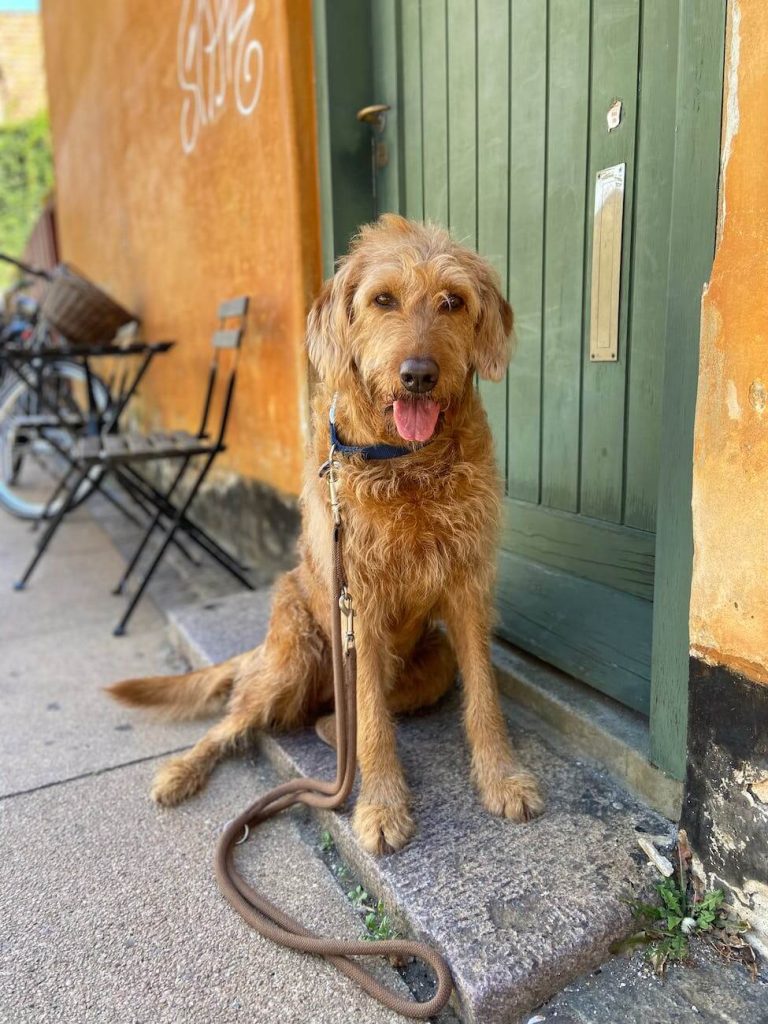
Can a labradoodle really be wire haired ??
Mar
Solving the mystery of the wire coated doodles
Once in a while, the question pops up in grooming groups on Facebook –
“ I have this dog on the table that the owner claims is a Labradoodle, but the coat is short and wiry
Sure, they must have been fooled by the breeder?.”
And a load of suggestions pops up: – it is crossed with a terrier or a schnauzer!
– it was clipped when it was too young, and the coat is destroyed now!
-it’s not a doodle…. It’s a German wire haired pointer!
Lots of suggestions, but all are wrong 😘
A poodle crossed with a Labrador can produce wire-haired pups, believe it or not….
That’s the wonderful world of coat genetics.
But how can that be possible?
Let’s start from scratch….
Before we start
When we talk about genetics, there are some important words we must remember from our science lessons in high school:
Phenotype – that is how the dog looks
Genotype– that is, the genes the dog carries
Phenotype and genotype can be different depending on the genes the dog carries.
The phenotype won’t always tell you the genotype. A dog can carry recessive genes -not visible until it meets a similar gene. Several different genotypes can look the same and have the same phenotype. And the other way around.
Locus – that’s where the genes are located in the DNA chain
Alleles – Alleles are different versions of a gene
The genotype is the combination of alleles a dog inherits from its parents at a particular genetic locus.
Dominant– only one set of the gene is necessary for the trait to be visible
Recessive – two sets of the gene must be present for the trait to be visible
Homozygote – the individual has 2 similar alleles of the trait – for example, LL
Heterozygote, the individual has 2 different alleles of the trait – for example, Ll.
Now, when we have refreshed our memory, let’s dive into the science!
Some of the genes that are involved in coat types
Hair growth in dogs is controlled by a dog’s coat’s type, length, texture, and shedding genes and their different alleles. These genes determine the type, length, texture, and shedding. It’s a complex system and would be a very long post if I went too detailed, so in this blog post, we will discuss some of the key genes involved in hair growth and their interactions with each other.
The main genes that affect the coat type are :
RSPO2 gene that controls furnishing -no furnishing, a small amount of furnishing, plenty of furnishing
It is also involved in controlling the coat texture and the length of the coat on the body.
FGF5 gene that controls the overall hair length – short hair or long hair
KRT71 gene that controls the presence of curls in the coat – straight coat, wavy coat or curly coat.
Both the furnishings gene and the curly gene are dominant, so you only need one copy to get a curly coat or a coat with furnishings. The long hair gene is recessive, so you need both copies to get long hair.
For the purposes of giving a basic understanding, I will use F for the furnishing gene, L for the long hair gene, and C for the curly hair gene. If the letter is noted as a capital, it is Dominant, and if it is a lowercase letter, it is Recessive.
FF or Ff – the dog will have more or less furnishing
ff – no furnishings
LL or Ll – short hair
ll – long hair
CC or Cc – curly or wavy hair
cc – straight hair

KRT71 Gene/ Curl gene
Dogs with curly coats have hair that forms tight curls or waves that cover most of their body.
Breeds with curls are, for example, Poodles, bichon frise
Breeds with waves are, for example, Portuguese waterdog
Different variants of this mutation affect different breeds.
Mode of Inheritance: Incomplete dominance
Alleles: c = No curl, C = Curl
- Dogs with the c/c genotype are expected to have a straight coat. They cannot transmit this curl variant to their offspring.
- Dogs with C/c genotype are expected to have a wavy coat. They may transmit this curl variant to 50% of their offspring. Mating between two N/C dogs is expected to produce 50% of puppies with wavy hair, 25% with curly hair, and 25% with straight hair.
- Dogs with the C/C genotype are expected to have a curly coat. They will transmit this curl variant to all of their offspring.
Furnishing Gene /the RSPO2 gene
is responsible for the development of “furnishings” in dogs, which are facial hairs -eyebrows, moustache.
It also controls the wire texture of the coat and, in some cases, the coat’s length on the body.
Phenotype: Dogs with furnishings have moustaches and eyebrow hair- so a hairy face
It’s dominant.
Alleles: f = No furnishings, F = Furnishings
- Dogs with f/f genotype are expected to lack furnishings. They cannot transmit this furnishing variant to their offspring and will transmit the non-furnishing variant to all of their offspring.
They have short-haired faces. - Dogs with the F/f genotype are expected to display furnishings but have a copy of the non-furnishing variant. They may transmit this furnishing variant to 50% of their offspring and the non-furnishing variant to 50%.
- Dogs with F/F genotype are expected to display furnishings. They will transmit this furnishing variant to all of their offspring, and they cannot transmit the non-furnishing variant to their offspring.
It is also responsible for not only the furnishing phenotype but also for determining the hair length of the entire body depending on the genetic background, suggesting an interaction between FGF5 and RSPO2 that influences the hair-length phenotype in dogs.
Lastly, there is the FGF5 gene. It controls coat length.
Five recessive mutations (variants) in the fibroblast growth factor-5 (FGF5) gene are associated with long hair phenotypes in dogs
The FGF5 gene produces a protein called fibroblast growth factor 5 (FGF5) that regulates the hair growth cycle.
Dogs with long coats have hair that is longer than 5 cm and covers most of their body. This coat type is seen in breeds such as Maltese, Shih Tzu, etc. The mutation on the FGF5 gene that causes long coat length is recessive, meaning that two copies of it are needed to produce this trait.
Different variants of this mutation affect different breeds. For example, Akita, Eurasier, Samoyed, and Siberian Husky have one mutation. Another one occurs in Afghans. A third one causes long-haired French Bulldogs.
Alleles: l = Short hair, L* = Long hair (five variants)
- Dogs with l/l genotype are expected to have short hair. They cannot transmit any of these long hair variants to their offspring.
- Dogs with l/L* genotype are expected to have short hair and are carriers of a long hair variant. They will transmit their long hair variant to 50% of their offspring. Mating between two carriers of a long hair variant is expected to produce 25% puppies with long hair,25% short haired that don’t carry the long hair gene and 50% short haired that carries the long hair gene.
- Dogs with the L*/L* genotype are expected to have long hair. They will transmit their long hair variant to all of their offspring.

Another gene is the W Locus
The W locus is another important gene that affects dog hair growth. This gene determines whether a dog will have a wire-haired coat or not. The W locus has two known alleles: W and w. Dogs with the WW or Ww genotype have wire-haired coats, while dogs with the ww genotype have smooth coats.
Genotypes:
- WW: Wire-haired Coat
- Ww: Wire-haired Coat depending on other genes.
- ww: Smooth Coat
There are also 2 non-shedding genotypes.
The non-shedding genotype caused by a mutation in the FGF5 gene affects hair growth and results in a non-functional protein that prevents shedding. This mutation affects the length and texture of a dog’s hair but does not affect the number of hair follicles.
On the other hand, the mutation of the MC5R gene affects the number of hair follicles and their growth cycle. This mutation results in a reduced number of hair follicles, which leads to a decreased ability to grow hair and, consequently, a reduced amount of shedding.
Therefore, while both mutations can result in a non-shedding phenotype, they are caused by different genetic variations and affect different aspects of hair growth and shedding.
Both genes that affect shedding are recessive, meaning that two copies of it are needed to produce this trait
.Dogs with two copies of this mutation (i.e., the ss genotype) are non-shedding, while those with one copy (i.e., the Ss genotype) may still shed to some extent.
. Dogs with high shedding have a normal variant of this gene, while dogs with low shedding have a mutated variant of this gene.
s/s non shedding
S/s low shedding
S/S normal shedding

The complex part of this
It’s important to note that all these genes do not work independently but rather interact with each other to determine the final coat type.
For example, the presence of the curly coat KRT71 gene can affect the length and texture of the hair, even if the dog has the short-haired FGF5 gene. Similarly, the presence of the furnishings FOXI3 gene can affect the growth pattern of the hair even if the dog has the short-haired FGF5 gene.
Some genes have additive effects, meaning they work together to produce a combined effect. For example, the FGF5 gene and the RSPO2 gene both affect hair length, but they do so independently. A dog with two copies of both genes will have longer hair than one with one copy of each gene.
Dogs that carry both the RSPO2 and KRT71 mutations display “curly wire” hair similar in texture to wire hair but longer and curled or kinked rather than straight. Long-haired breeds carry the variant form of FGF5.
Dogs carrying the FGF5 mutation, along with the RSPO2 insertion, have furnishings and long soft coats, rather than wiry ones. When dogs carry variants in both FGF5 and KRT71, the coat is long and curly.
Not surprisingly, coats must be of sufficient length to curl, and all curly-haired dogs are homozygous for the FGF5 mutation. Finally, the phenotype is long and curly with furnishings if all three mutations are present.
. Examples of this type of breed include poodles and Portuguese water dogs.
Let’s examine a practical example of how the genes interact and their impact on the coat: the English cocker spaniel.
Gene interactions can create different genotypes even within the same breed.
One dog can have F/f for furnishing, so it has a bit of hair on the face and a bit longer hair on the body. Another one has F/F for furnishing, which gives it a hairy face and much more hair on the body, just longer but thicker. The third one has F/F, so it has a smooth face, a shorter, slicker coat on the body, and not much furnishing on the legs.
This explains why we see the working lines with smooth bodies and quite short furnishing and the show lines with lots of hair on both the body and legs and in the face.
Combining the genes
If we combine all the genes, we can see technically 7 different phenotypes.
I have added one example of each so that you get a better picture of it:
(A) short hair – Basset – no explanation needed 😊
(B) wire hair – Australian terrier ( straight wire coat with straight hair in the face and the same length on the legs . They tend to stay straight haired when we clip them )
(C) “curly-wire” hair – Airedale terrier ( wire coat that has longer, fluffier hair in the face/legs-you can also see that they have a tendency to go curly when we clip them )
(D) Long hair – Golden retriever ( long coat with short face )
(E) long, soft hair with furnishings – Bearded Collie ( long coat with hairy face )
(F) long, curly hair – Irish water spaniel ( long curly hair with short face )
(G) long, curly hair with furnishings – Poodle ( long curly coat with hairy face )
Puppies inherit genes from both parents. They get 50% from mum and 50% from dad.
But it’s randomly distributed, and all pups in the litter get different combinations.
This is why if you cross 2 breeds, you can have 4 different-looking pups in a litter.
An example:
Poodles have two copies of the furnishing gene, having hairy faces (FF), while golden retrievers have none (ff). When they are crossed to produce “Goldendoodles”, the offspring will inherit one copy from each parent (Ff) and will have furnishing -aka hairy faces.
But if you cross 2 golden doodles with each other, there is a 25% chance that you get offspring with smooth faces as they inherit the genes for lack of furnishing from both parents and if they meet up in the same pup, you get the smooth face.
Same if you cross a Poodle and a Labrador.
All pups will have hairy faces as the furnishing gene is dominant. They will have a chance of being wire-haired in texture, as the Labrador carries a gene for thick, strong guard hair, and the poodle carries a gene for a long, curly coat. When they are combined, you can get a “wire-curly” coat.
This is why professional breeders of “Labradoodles” do gene testing on their dogs to ensure that the dogs they use for breeding don’t carry the genes that can give wire-haired or short-haired pups.
They also test for shedding genes to guarantee the claim that they are non-shedding.
Another common comment we see in grooming groups is when people bring in a “cockerpoo” that looks like a cocker spaniel, and everyone says,” -ohhhh they got tricked by the breeder “
But if you cross a cocker with a smooth face and shortish coat with a poodle – you get pups that have fluffy faces but carry the smooth face gene.
They get curly coats but can get a shorter coat gene from the cocker. Cross one of them with a cocker or a similar cross, and you will have “cocker-type” pups again.
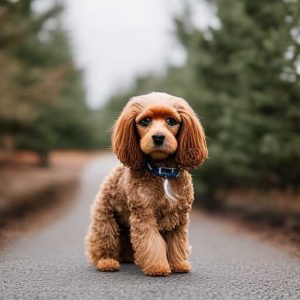
How do I calculate the outcome when I cross 2 breeds?
Do you remember Mendel? The guy that we read about in biology that created ” Mendel’s law of segregation”
He crossed sweat peas with different colours and did up what is called a Mendelian chart to illustrate the predicted outcome.
We must remember that this is based on statistics out of 100 offspring, and dogs rarely have that in one litter…. But it will give us a statistical indication of what we can expect.
You create a chart listing one of the parents’ genes in the top row and the other parent’s genes in the side row. This is also called a Punnett chart.
And then it’s just a case of adding each letter to each box below/to the side of the gene.
Here’s a Mendelian chart /Punnett chart for the cross between a dog with the genotype for furnishing and a long curly coat (ll CC FF) -a poodle, for example, and a dog with the genotype for short, smooth coat and no furnishing (LL cc ff) – a basset for example

They will all have the same genotype lLCcFt –
this means the phenotype will be
a dog with short wavy wire hair and some hair in the face.
Let’s say that we mate 2 of the pups with each other and suddenly we have a chance of 27 different combinations ….
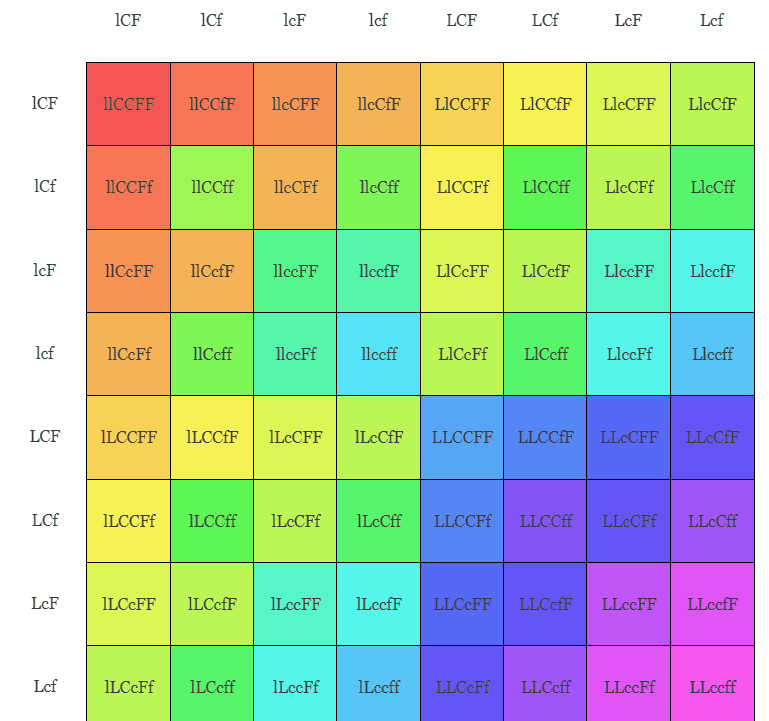
I have written the phenotype on some of them to illustrate the differences you can see in the same litter
|
Genotype |
Count |
Percent |
|
LlcCfF |
8 |
12.5 shorthaired with slightly wavy wire hair and some facial hair |
|
llcCfF |
4 |
6.3 longhaired wavy wire with some facial hair |
|
LlCCfF |
4 |
6.3 shorthair curly wire hair with facial hair |
|
LlcCFF |
4 |
6.3 |
|
LlcCff |
4 |
6.3 |
|
LlccfF |
4 |
6.3 |
|
LLcCfF |
4 |
6.3 |
|
llCCfF |
2 |
3.1 |
|
llcCFF |
2 |
3.1 longhair wavy with a fully hairy face |
|
LlCCFF |
2 |
3.1 |
|
llcCff |
2 |
3.1 |
|
LlCCff |
2 |
3.1 |
|
llccfF |
2 |
3.1 |
|
LlccFF |
2 |
3.1 |
|
Llccff |
2 |
3.1 |
|
LLCCfF |
2 |
3.1 |
|
LLcCFF |
2 |
3.1 |
|
LLcCff |
2 |
3.1 |
|
LLccfF |
2 |
3.1 |
|
llCCFF |
1 |
1.6 |
|
llCCff |
1 |
1.6 longhair wavy with a smooth face |
|
llccFF |
1 |
1.6 |
|
llccff |
1 |
1.6 Long hair straight with a short face |
|
LLCCFF |
1 |
1.6 |
|
LLCCff |
1 |
1.6 |
|
LLccFF |
1 |
1.6 |
|
LLccff |
1 |
1.6 shorthair with straight hair and smooth face |
27 different combinations! A lot of them will look roughly the same for the naked eye …. But can you see now why we can’t predict the outcome when we cross breeds?
We can guess, but as there are so many factors that interfere, you can never look at a dog and say, “It must be…..

Some final thoughts
I guess your head is spinning now after all the technical terms, shortcodes, and stuff…
So was mine while doing the research for this write up 😂
But why did you make it so complicated, one may ask? And so long 😱??
One reason is that I want to show how complicated this is. There are so many factors that determine how the coat comes out in one individual.
Remember the English cocker spaniel I talked about earlier? The difference in the look between the working lines and the show lines is due to the different genes and how they interact with each other.
This means that if you cross a working cocker with a poodle, you get one set of genes into the mix, but if you instead use a show cocker, another set of genes will be thrown into it. It is like you have crossed the poodle with 2 different breeds.
This is why poodle/cocker crosses can look anything from a cocker to a poodle and anything in between……
Another reason is that I want to show that we can’t judge a dog’s genetic background based on an image…
There is no use in posting images in a group and saying- the owner rescued this dog; what breeds do you say are in it?
We can’t determine the genetic set up of a dog by looking at it. Remember that the interaction between the genes causes new combinations that can manifest in a completely different coat compared to the parents.
And the dog could be a mix of 3,4,7, or 10 different breeds, and by this time, it’s a can of alphabet soup with letters just randomly chosen to combine.
The last reason is that you shouldn’t base your grooming approach on the dog’s breed/breeds; your approach should be based on the coat type of the dog in front of you.
It doesn’t matter if the dog is a cross with a double-coated breed; if the dog in front of you looks like a poodle, then treat it like a poodle. If it looks like your average double-coated breed, then treat it like a double-coated breed.
What a fascinating read, thank you for this education!
Great job on the genetics research and reporting. One detail, respectfully – the word ‘technically’ seems substituted for other words in places?
“They technically get 50% from mum and 50% from dad.” They actually, biologically, get 50% from each.
“if you cross 2 golden doodles with each other, you will technically have 25% with smooth faces as they inherit the genes for lack of furnishing from both parents.” ‘Technically’ there will be 25% chance that there will be pups with smooth faces. As noted later in the write-up, given maybe 100 offspring from this pairing, about 25 will have smooth faces. In a single litter, you get what you get :).
And, as with human children, there are other factors that affect which genes ‘win’ in the fertilization and growth game. Some people produce boys a LOT, others girls and not boys (etc.), so that simple statistical probability works in large numbers, but ‘your results may vary’.
Thanks especially for the solid tip – groom the coat in front of you, not the conceptual genetic makeup. Without being able to articulate it as a question, turns out that’s something I wanted to know!
The rest was simply interesting and fun. Thank you!
Thanks!
You are so right when it comes to the wording.
As english is not my first language, my brain sometimes goes in to a mixed state between my two languages and this is the result 🫣🤣
Thank you for the suggestions how to edit it- I will implement them🥰
And thanks for your kind words about my work .
Thanks for the info. I would love to share a pic of my dog Grizzly. Wirehaired labradoodle
Hi Beth!
Please share a picture and I can add it to the post ❤️
So interesting! We adopted our dog from our local rescue, she was a stray but from experience they thought she was a Labrador crossed with a toy
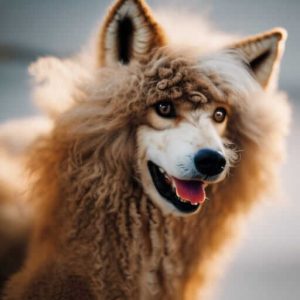
Poodle! She so wire haired and nothing like what you’d expect her to look like – people laughed and said no.. definitely terrier in her, so we did a DNA test and she is 50% Labrador 50% toy poodle! 🤣 she looks exactly like the dog in your pic but smaller! Would love to share a pic for you to see!
please share it ☺️ You can email me a mia@dreamdogz.ie
I love to see her and with your permission add her to the post so people can see a real life example of how genetics work ☺️